
ESCAPADE
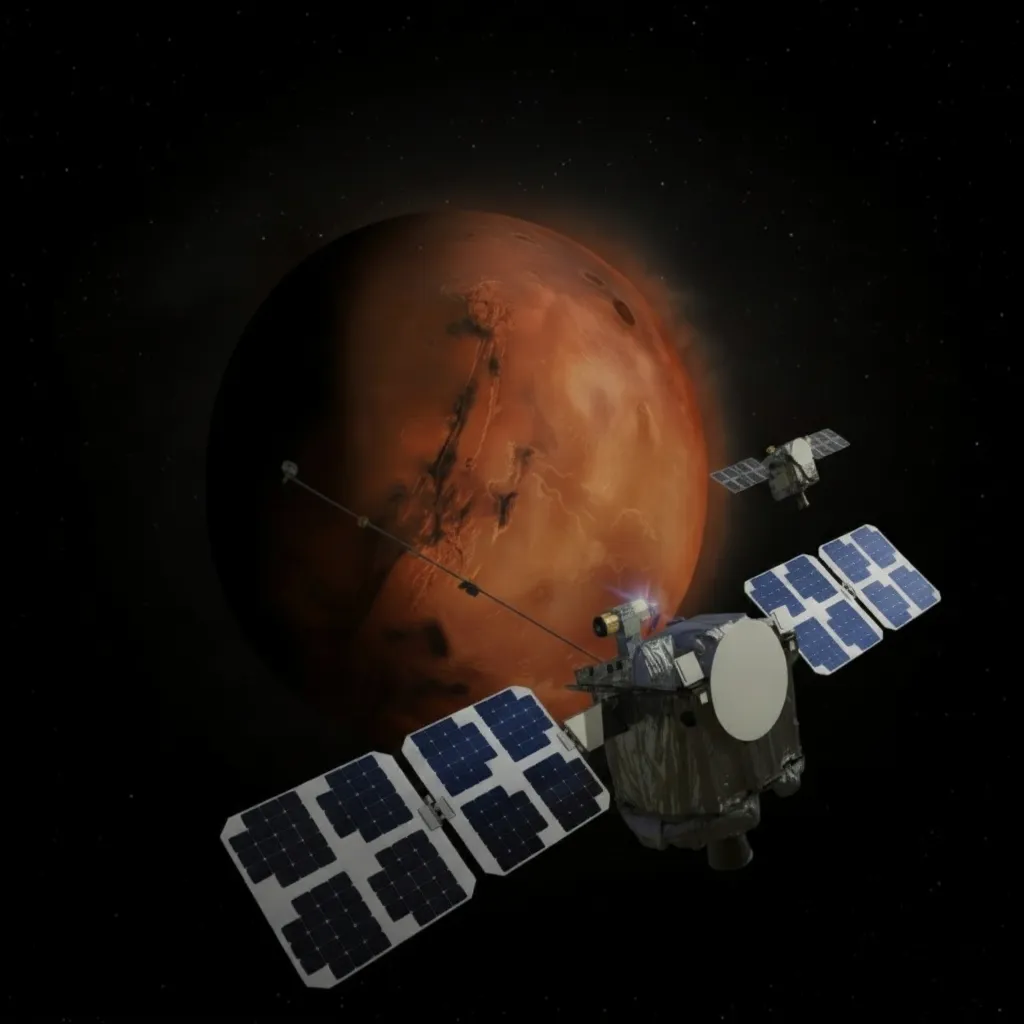
ESCAPADE revolutionizes Martian exploration with twin low-cost probes built on Rocket Lab's Explorer bus. Launched in November 2025 via a New Glenn rocket, the mission validates commercial components and L2 loitering orbits to perform multipoint measurements of the Martian magnetosphere.
Agency

Country

Type
Orbiter
Status
Launch
November 13, 2025
COSPAR Designation: 2025-175A and 2025-175B
Official Name: Escape and Plasma Acceleration and Dynamics Explorers (ESCAPADE) - Blue (SIMPLEx-4A) and Gold (SIMPLEx-4B) spacecraft
Responsible Space Agency: NASA (Managed by the Space Sciences Laboratory at the University of California, Berkeley)
Launch Date and Time: November 13, 2025, 20:55:01 UTC
Mars Orbit Insertion (MOI) Date and Time: September 2027 (Planned; Gold spacecraft precedes Blue by 48 hours)
Landing Site / Coordinates: Not applicable (Exclusively orbital mission)
Launch Vehicle: Blue Origin New Glenn (Certification flight NG-2)
Current Mission Status: Operational (Loiter and calibration phase in the vicinity of the Earth-Sun L2 Lagrange point)
1. Historical Context and Detailed Objectives
The ESCAPADE mission was born within NASA's Small Innovative Missions for Planetary Exploration (SIMPLEx) program, conceived to address one of the most challenging questions in planetary science: how the solar wind strips Mars of its atmosphere. Unlike planets with an intense global magnetic field like Earth, Mars possesses a hybrid magnetosphere and remnant magnetic field patches embedded in its crust. Previous single-spacecraft missions could not determine whether a plasma fluctuation was a planet-wide temporal change or a local spatial structure. ESCAPADE aims to fill this gap by utilizing twin identical spacecraft measuring simultaneously for the first time.
The primary objective of the mission is to characterize the processes of plasma acceleration, dynamics, and escape in the Martian environment in three dimensions. This includes quantifying the fluxes of ions and electrons leaving the planet and understanding how they respond to solar coronal mass ejections. As secondary objectives, the probes will map the planet's magnetic boundaries (the bow shock and magnetopause) and record the behavior of the lower ionosphere, providing critical data to model the climatic and historical evolution of water on Mars.
2. Vehicle Architecture and Main Subsystems
Each of the ESCAPADE probes utilizes Rocket Lab's Explorer bus, a design derived from the Photon high-energy platform. The central structure consists of an aluminum cube measuring 1 meter per side. The dry mass of each satellite is 209 kg, reaching a maximum wet mass of 535 kg after propellant loading. Thermal control is strictly passive, based on multi-layer insulation (MLI) blankets wrapping the chassis to protect internal components from the extreme temperatures of the areocentric environment, keeping propellant lines above their freezing points via modular survival heaters.
The propulsion system is a chemical hypergolic liquid bipropellant type, supplied by ArianeGroup. It uses monomethylhydrazine (MMH) as fuel and mixed oxides of nitrogen (MON-3) as oxidizer, pressurized by helium gas in carbon-fiber overwrapped pressure vessels. This system generates a total incremental velocity (Delta-V) budget exceeding 2500 m/s. For power generation, two steerable solar arrays produce up to 288 W at Martian aphelion (at 1.67 Astronomical Units from the Sun), powering the systems and recharging lithium-polymer batteries. The average power consumption of the scientific payload is 128 W.
The attitude determination and control subsystem (ADCS) employs a star tracker, sun sensors, and an inertial measurement unit (IMU), executing physical corrections via three precision reaction wheels. Angular momentum desaturation is performed by a cold-gas reaction control system (RCS) loaded with 12 kg of nitrogen. Telecommunications are managed through Rocket Lab's Frontier-X X-band transceiver, operating at frequencies of 7.2 GHz for uplink and 8.4 GHz for downlink via a 60 cm parabolic antenna. The system supports the Deep Space Network's (DSN) Multiple Spacecraft Per Aperture (MSPA) technique, allowing data to be received from both naves simultaneously using a single ground antenna.
3. Payload and Scientific Instrumentation
The ESCAPADE Magnetometer (EMAG), developed by NASA's Goddard Space Flight Center, is a fluxgate-type sensor mounted on a 2-meter deployable carbon fiber boom. Its detection range spans from 0 to 2000 nT with an accuracy of 0.5 nT. Its purpose is to measure the direction and strength of the local magnetic field. To understand how it works, it operates analogously to a highly sensitive three-dimensional compass that, instead of just pointing north, registers the subtle deformations that the solar wind causes in the planet's magnetic lines.
The Electrostatic Analyzers (EESA) instrument, designed by the Space Sciences Laboratory at UC Berkeley, is divided into two channels. EESA-e measures suprathermal electrons in a range of 3 eV to 10 keV with a 240 by 120-degree field of view. EESA-i is an ion mass spectrometer covering energies from 0.1 eV to 30 keV and determines the mass-to-charge ratio from 1 to 60 atomic mass units, discriminating between solar protons and heavy atmospheric ions such as molecular oxygen or carbon dioxide. It works similarly to a coin selector in a vending machine: particles enter and, based on their speed and electrical charge, are deflected into specific trajectories that reveal exactly which chemical element they are.
The ESCAPADE Langmuir Probe (ELP), provided by Embry-Riddle Aeronautical University, has a mass under 600 grams and consumes less than 1 W. It features an mNLP instrument with four thin needles that measure ionospheric thermal electron density in ranges from 100 to 50,000 per cubic centimeter, along with planar probes for local ion flux and a floating potential sphere for the spacecraft chassis (between plus and minus 12 V). Its physical principle is identical to dipping a thermometer into a fluid: by applying a known voltage to the needles exposed to space, the resulting electrical current reveals the density and "temperature" of the surrounding plasma.
The Visible and Infrared Observation System (VISIONS), developed by Northern Arizona University and Lucint Systems, weighs 602.7 grams and is housed in an aluminum chassis. The visible channel features a Bayer-matrix CMOS sensor with wide-angle lenses (39 by 33-degree field of view), providing a resolution of 3.2 km per pixel at an altitude of 8400 km to capture auroras and nightglow. The infrared channel uses uncooled vanadium oxide microbolometers (45 by 37-degree field of view) operating between 8 and 14 micrometers with a resolution of 34 km per pixel to construct thermal maps of the surface and track local dust storms. It functions just like a dual-lens home security night camera, simultaneously capturing optical shapes and the heat emitted by the planet.
4. Launch Vehicle and Flight / EDL Profile
The twin probes lifted off on November 13, 2025, aboard Blue Origin's New Glenn rocket on its second certification flight (NG-2). Payload separation occurred at 33 minutes of flight, after which the rocket's first stage performed a propulsive landing on the Jacklyn marine platform. Due to the closure of the direct ballistic window to Mars in 2024, the trajectory designed by Advanced Space LLC introduced an innovative one-year "loiter" phase in an elliptical orbit around the Earth-Sun L2 Lagrange point. This strategy allows the spacecraft to wait passively until the planetary positions align optimally.
In November 2026, the spacecraft will execute a hyperbolic gravitational assist maneuver over Earth, passing at an altitude of approximately 600 km. At perigee, they will perform the Trans-Mars Injection (TMI) burn, adding 600 m/s of velocity to enter an 11-month Type II heliocentric transfer. Six trajectory correction maneuvers (TCM) are scheduled during cruise. TCM-3 will be deterministic, absorbing 96% of the Mars B-plane approach vector while deliberately withholding 4% to ensure the trajectory error ellipsoid does not cross the atmospheric impact corridor. Mars Orbit Insertion (MOI) will take place in September 2027 via an 11-minute inertial braking burn, establishing an initial 60-hour orbit that will be subsequently reduced through apoapse (ARM-G) and periapse (PRM-G) maneuvers to establish a safe scientific periapsis at 155 km altitude.
5. Operational Progress and Scientific Results
As the spacecraft are currently in the loiter phase at the L2 Lagrange point, the timeline for active operations at Mars will nominally begin after the solar conjunction period in June 2028, extending for an 11-month primary science phase. Data collection will be structured in two distinct phases. In Campaign A (String-of-Pearls configuration), both probes will share the same elliptical orbital plane with a 160 km periapsis and an 8400 km apoapsis. Their temporal separation will be dynamically controlled via cold-gas burns to oscillate between 0 and 30 minutes, allowing scientists to determine whether magnetic disturbances at the magnetospheric boundaries are large-scale global variations or localized spatial structures.
Campaign B (Dispersed Orbits) will alter the orbital periods of the satellites (Blue to a 6.6-hour orbit with an apoapsis of 10,000 km, and Gold to a 4.9-hour orbit with an apoapsis of 7,000 km). Mars' polar oblateness will induce differential precession, progressively separating their orbital planes in space. This will allow one probe to act as an external solar wind monitor in undisturbed interplanetary space, while the other simultaneously measures the ionospheric response and escape rates of heavy ionic species in the deep atmosphere, correlating cause and effect in Martian space weather for the first time.
6. Conclusion and Technical Legacy
The ESCAPADE mission redefines the economics of deep interplanetary exploration by demonstrating the viability of multipoint scientific platforms based on low-cost commercial buses and commercial off-the-shelf (COTS) components. The successful integration of advanced plasma instruments into compact spacecraft paves the way for future microsatellite constellations dedicated to environmental and climatic studies across the solar system. Furthermore, the astrodynamic validation of loitering phases at Lagrange points breaks the strict dependency on direct planetary launch windows, offering unprecedented flexibility for secondary and opportunistic deep space science missions.
Mission Milestones
Launch
SOL 23 OF MARINERO OF YEAR 38
273 days (~265 sols)
of travel so far