
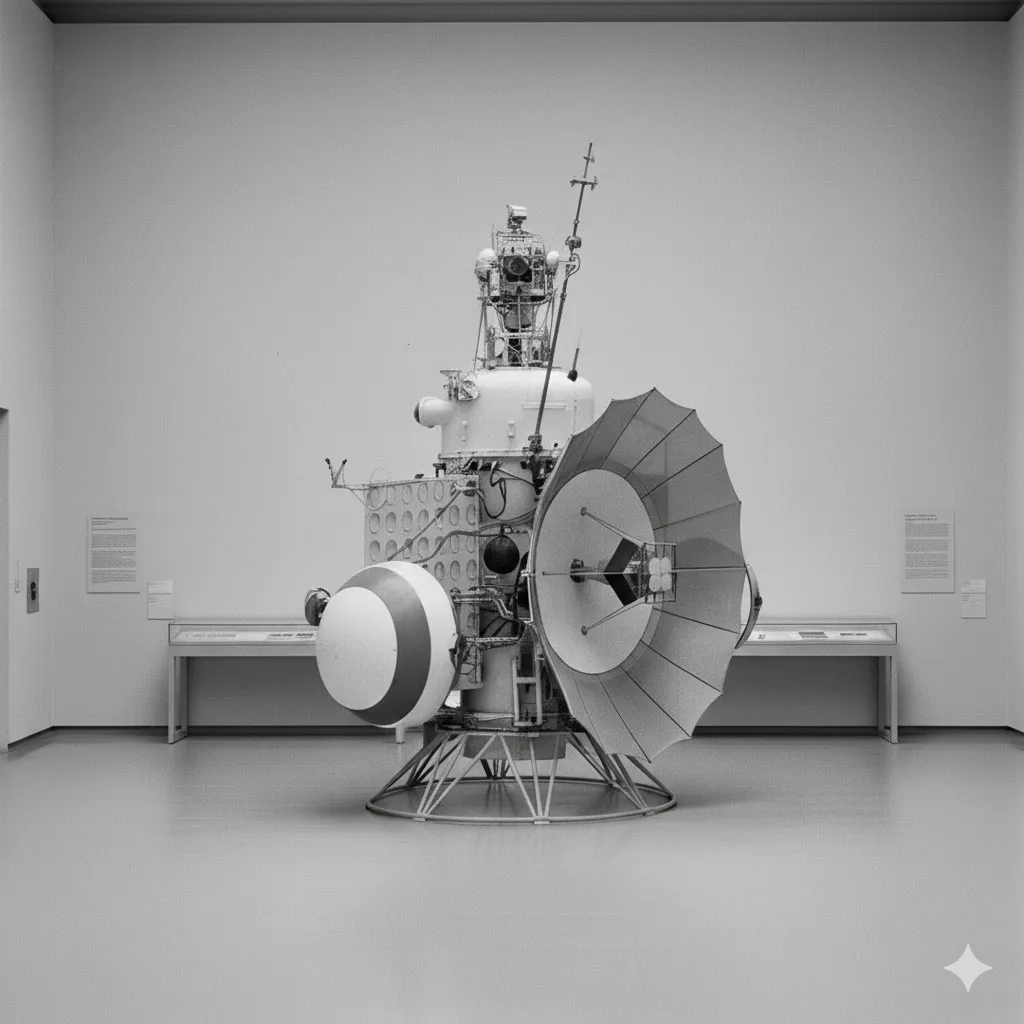
Mars 2MV-4 No.1 (Sputnik 22)
The Soviet Mars 2MV-4 No. 1 probe (Sputnik 22) failed on October 24, 1962, when its Blok L upper stage exploded in LEO due to a seized staged-combustion turbopump. Its debris triggered a false ICBM attack alarm in Alaska, averted via vector tracking during the height of the Cuban Missile Crisis.
Agency

Country

Type
Flyby
Status
Launch
October 24, 1962
COSPAR Designation: 1962-057A
Official Names: Mars 2MV-4 No. 1 (OKB-1 internal designation), Sputnik 22 (Western/NORAD designation)
Responsible Space Agency: Soviet Union Space Program (OKB-1 led by Sergei Korolev)
Launch Date and Time: October 24, 1962, at 17:55:04 UTC
EDL / Mission End Date and Time: October 24, 1962, at ~19:11 UTC (Catastrophic failure in Low Earth Orbit during trans-Mars injection)
Geographical Launch Site: Site 1/5, Baikonur Cosmodrome, Kazakh SSR
Launch Vehicle: Molniya 8K78
Current Mission Status: Failure due to destruction of the injection stage. Destroyed and reentered the atmosphere as debris.
1. Historical Context and Detailed Objectives
In the early 1960s, the Soviet Union sought to consolidate its leadership in the space race by expanding its capabilities into deep interplanetary exploration. The second-generation program, internally designated as the 2MV modular platform, was formally approved by the OKB-1 design bureau on July 30, 1961. Its fundamental purpose was to overcome the high failure rates of the 1960 Mars 1M misiones through a standardized bus architecture. This platform shared a common core design for propulsion and support, altering only the upper scientific module or planetary compartment to adapt to either flyby or landing missions to both Venus and Mars.
The Mars 2MV-4 No. 1 spacecraft (Sputnik 22) represented the first attempt at a Martian flyby utilizing this new modular architecture. Scientifically, the mission intended to fill an absolute void of empirical data regarding the environmental conditions of Mars. Primary objectives focused on characterizing the Martian atmosphere, detecting water vapor or ozone, photographic mapping of the surface, and searching for signs of organic activity through spectral signatures. Secondary objectives included measuring solar plasma, magnetic fields, and micrometeorite density in the deep heliocentric space between Earth and Mars.
2. Vehicle Architecture and Main Subsystems
The 2MV-4 platform featured a cylindrical configuration with a total height of 3.6 meters, a core diameter of 1.1 meters, and a total launch mass of 893.5 kilograms. Its structural design was divided into three hermetic sections: the orbital compartment, the special navigation instrumentation compartment, and the planetary flyby compartment mounted at the base.
The orbital compartment was pressurized to 1.1 bar with dry nitrogen. This allowed the electronics to operate under conditions similar to an Earth laboratory, dissipating heat via forced convection using internal fans. Active-passive thermal control utilized two independent fluid loops (ditolylmethane for heating and isooctane for cooling) coupled to hemispherical radiators covered with 40 layers of aluminized terylene multilayer insulation. This system maintained internal components within a strict range of 20°C to 30°C.
Power generation depended on two flat solar panels with a total area of 2.6 square meters, capable of supplying a direct current of 1.3 to 2.6 amperes. This power charged a nickel-cadmium battery bank with a capacity of 42 ampere-hours. Telecommunications used a high-frequency transmitter coupled to a high-gain parabolic antenna. Because transmitter power demands exceeded the synchronous generation capacity of the solar panels, scientific and engineering data were continuously recorded onto an internal magnetic tape recorder and transmitted in delayed bursts during peak active power sessions.
To understand the operation of data storage and burst transmission, let us imagine a water tank that fills slowly with a steady flow (the scientific data accumulated on the magnetic tape), but empties its entire volume by opening a large floodgate all at once for a few minutes when a distant field needs high-pressure irrigation (the high-power transmission to Earth).
Three-axis attitude control was executed via cold-gas microthrusters (compressed nitrogen) fed by external titanium tanks, coordinated by high-precision gyroscopes, solar sensors, stellar sensors (locking onto Canopus or Sirius), and planetary horizon sensors.
3. Payload and Scientific Instrumentation
The onboard scientific instrument suite was strictly divided according to the vehicle module:
Planetary Module (Mars Flyby)
- Bratslavets Photo-Television System: Mass of 32 kilograms. It utilized a 750 mm telephoto lens and a 35 mm wide-angle lens. It exposed a special 70 mm chemical film that was automatically developed and dried onboard in microgravity. Subsequently, a flying-spot scanner read the film to transmit an analog video signal in the 5 cm band (3691.04 MHz) at a speed of 90 pixels per second. A clear analogy for this system is the operation of a conventional office fax machine: the physical document (the developed film) is scanned line by line by a slow optical reader that converts the variations of light and shadow into electrical tones to send them over the phone line.
- Ozone Absorption Ultraviolet Spectrograph: Developed by Lebedinskii and Krasnopol'skii. It operated in the 190-275 nm and 285-355 nm ranges to identify the presence of ozone in the upper layers of the atmosphere. It projected spectral lines directly onto the margins of the Bratslavets camera film to save mass.
- Sinton Band Infrared Spectroreflectometer: Designed to detect absorption features in the 3 to 4 micrometer infrared band, aiming to verify the existence of carbon-hydrogen chemical bonds hypothetically associated with vegetation or organic matter on the surface.
Orbital Module (Interplanetary Space)
- High-Sensitivity Uniaxial Magnetometer: Manufactured under the direction of Dolginov, mounted on a carbon-fiber boom to mitigate magnetic interference from the spacecraft's main structure.
- Vernov Radiation and Cosmic Ray Monitors: Composed of two STS-5 Geiger-Müller counters and scintillation counters using sodium iodide (NaI) and cesium iodide (CsI) crystals to measure solar wind particle fluxes and search for Martian radiation belts.
- Cherenkov Radiation Counter: Developed by Kurnosova to specifically record the flux of heavy nuclei in primary cosmic rays.
- Gringauz Ion Traps: Hemispherical and planar modulation sensors to determine the density and effective temperature of low-energy space plasma components.
- Nazarova Micrometeorite Impact Plates: Piezoelectric sensors mounted directly onto the back of the solar panels (useful area of 1.5 square meters) to record the acoustic impulses of hypervelocity cosmic dust collisions.
- Slysh Cosmic Radio Astronomy Receiver: Operated between 200 kHz and 2000 kHz using an extended metal tape antenna to characterize background galactic radio noise at wavelengths of 150 and 1500 meters, which suffer complete attenuation and blocking when measured from Earth due to the ionosphere.
4. Launch Vehicle and Flight Profile / EDL
The flight profile required inserting the spacecraft into a transient low Earth parking orbit and subsequently executing a second burn for Trans-Mars Injection (TMI). The launch vehicle utilized was the four-stage Molniya 8K78 heavy rocket.
The lower stages (Blok B, V, G, D boosters and the core Blok A) provided a total vacuum thrust of 4020 kN burning liquid oxygen (LOX) and military-grade kerosene. Following booster separation at 119 seconds and core separation at 301 seconds, the third stage (Blok I) burned for approximately 200 seconds with its 294 kN thrust RD-0108 engine, placing the upper assembly into a circular parking orbit at an altitude of 180 kilometers and an inclination of 64.9°.
The fourth stage, designated Blok L, was responsible for executing the interplanetary injection after a prolonged orbital coast phase in weightlessness. This stage housed the S1.5400A1 engine, designed by V. M. Melnikov's bureau at OKB-1. This propulsion unit possesses monumental historical significance as the world's first operational engine to employ the oxidizer-rich staged combustion cycle (closed-loop). The engine had a dry mass of 153 kilograms, operated under a chamber pressure of 5.4 MPa, and developed a net vacuum thrust of 66.69 kN with an exceptional specific impulse of 340 seconds.
To illustrate the complexity of the oxidizer-rich staged combustion cycle, we can imagine a car engine where the hot exhaust gases are not expelled out the tailpipe, but are forced to pass first through a turbine to give the engine more power, and are then re-injected back into the cylinders to burn every last drop of fuel without losing absolutely any energy.
Ninety minutes after liftoff, the automatic ignition sequence for the Blok L commenced. However, exactly 16 seconds into the burn of the S1.5400A1 engine, a catastrophic anomaly occurred. A defective mechanical seal allowed a rapid leak of lubricant out of the high-pressure turbopump assembly. The resulting mechanical friction caused massive thermal overheating and instantaneous seizing of the turbopump rotors. The violent interruption of propellant flow caused residual liquid oxygen to react uncontrollably within the hot preburner zone, generating a destructive overpressure that ruptured the main combustion chamber. The explosion instantly destroyed the Blok L stage and the attached spacecraft, canceling the mission before it could leave low Earth orbit.
5. Operational Development and Scientific Results
Due to the catastrophic failure during the trans-Mars injection phase, the Sputnik 22 spacecraft never executed active operations in heliocentric space or in the vicinity of Mars. No geochemical, spectrographic, or photographic data of the target planet were obtained.
Active mission operations were limited to the 90 minutes spent in low Earth orbit (LEO). The explosion generated a dense cloud of space debris. This event coincided critically with the height of the Cuban Missile Crisis. US Ballistic Missile Early Warning System (BMEWS) radar stations in Clear, Alaska, detected the sudden fragmentation and initially interpreted it as a mass nuclear strike of Soviet ICBMs equipped with multiple independently targetable reentry vehicles (MIRVs). A nuclear escalation was averted within seconds due to rapid vector analysis by military operators, who confirmed that the fragments possessed strictly orbital trajectories with zero ballistic descent velocity component.
NORAD cataloged 22 major fragments resulting from the detonation (assigned under COSPAR identifier 1962-057 and NORAD catalog numbers including 443, 482, and 501). Due to the low altitude of the orbital perigee, atmospheric drag rapidly degraded their orbits, causing the complete thermal reentry and destruction of all debris between October 29, 1962, and February 26, 1963.
6. Conclusion and Technical Legacy
The Mars 2MV-4 No. 1 mission demonstrated the validity of Sergei Korolev's modular interplanetary platform concept. The logical guidance subsystems, dual-fluid active thermal control, and core support architecture functioned correctly during the initial launch and orbital coast phases. The technical legacy of this modular bus served directly as the design foundation to optimize the Mars 1 (1962) mission and the subsequent Venera deep-space exploration series.
However, the mission's failure highlighted that the bottleneck of the Soviet interplanetary program lay in the low operational reliability of upper-stage liquid propulsion systems when subjected to prolonged weightlessness. The S1.5400A1 engine, despite its revolutionary thermodynamic design, proved that staged combustion technology required extremely strict metallurgical tolerances and quality controls regarding fluid seals and turbopump joints. The optimization and resolution of these mechanical flaws in subsequent years ultimately allowed the Blok L to mature into a highly reliable and efficient injection stage for later planetary missions.
Mission Milestones
Launch
SOL 6 OF ACIDALO OF YEAR 5