
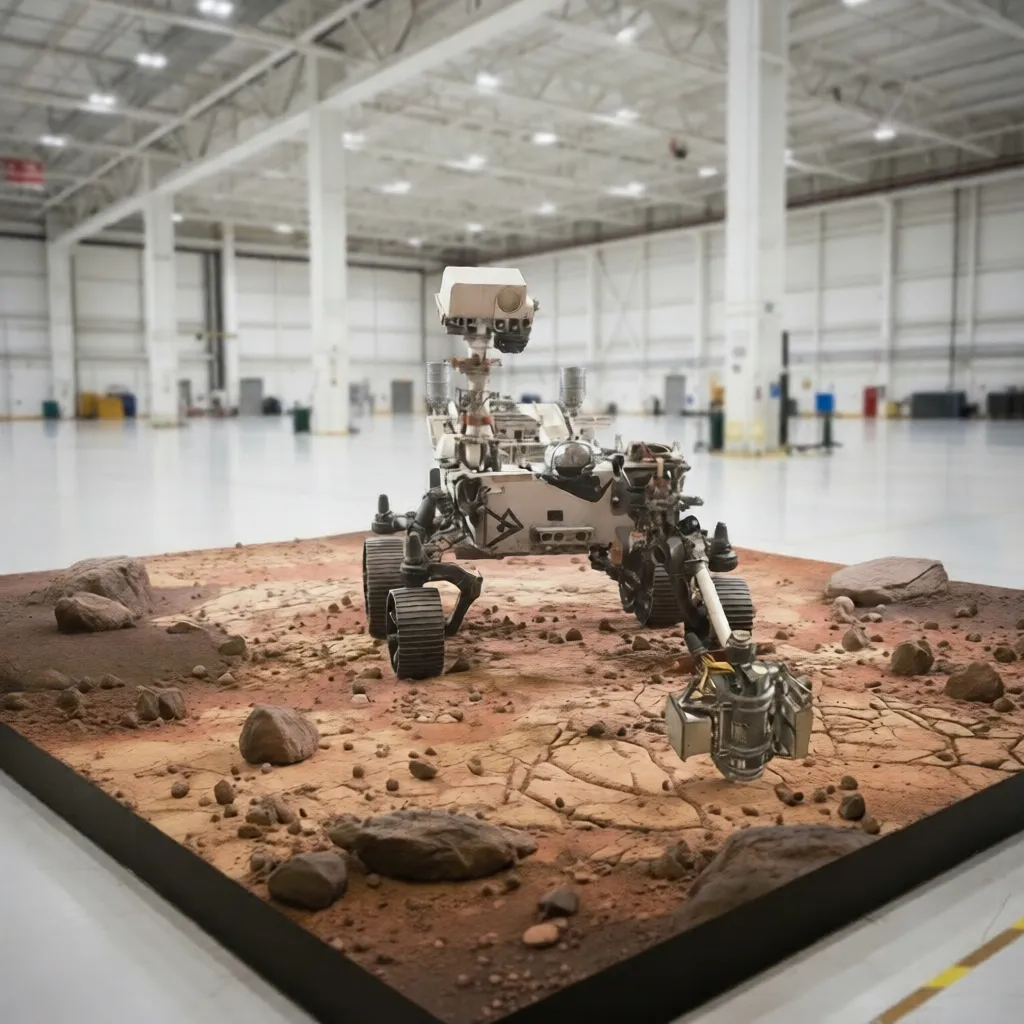
Perseverance
The Mars 2020 mission established a milestone in planetary robotic exploration by landing the Perseverance rover in Jezero Crater. Its architecture, powered by the MMRTG nuclear generator and the AutoNav algorithm, has enabled over 42 km of surface driving. The success of the hermetic titanium sample sealing system with negligible leak rates and the electrochemical production of oxygen via the MOXIE instrument provide the empirical engineering foundation for the Mars Sample Return campaign and future human exploration of Mars.
Agency

Country

Type
Rover
Status
Launch
July 30, 2020
COSPAR Designation: 2020-052A
Official Names: Mars 2020 (Perseverance Rover)
Responsible Space Agency: NASA (National Aeronautics and Space Administration) / JPL (Jet Propulsion Laboratory)
Launch Date and Time: July 30, 2020, 11:50:00 UTC
EDL (Landing) Date and Time: February 18, 2021, 20:55:00 UTC
Landing Site: Jezero Crater, Mars (Coordinates: 18.38° N, 77.58° E)
Launch Vehicle: Atlas V-541
Current Mission Status: Operational / Mission Extension
1. Historical Context and Detailed Objectives
The Mars 2020 mission was born as the logical evolution of the robotic exploration of the Martian surface, capitalizing on the proven mechanical design of its predecessor, the Curiosity rover launched in 2011. After confirming the ancestral presence of liquid water and potentially habitable environments through previous missions, the planetary science community identified an imperative need to transition from the mere search for habitability toward the direct search for signs of life from the Martian geological past (biosignatures). The scientific gap it intended to fill lay in the lack of geochemical and mineralogical evidence analyzed at the micrometric scale, as well as the absence of pristine physical samples that could be returned to terrestrial laboratories for subsequent high-sensitivity analysis.
The primary objectives of the mission are divided into four fundamental pillars: the characterization of the geological environment of Jezero Crater, which once hosted an ancient lake and river delta system; the search for signs of ancient life preserved in sedimentary rock structures; the storage of cylindrical rock and regolith cores using an ultra-clean sampling system; and preparation for human exploration through technology demonstrations of in-situ resource utilization. As secondary objectives, the mission included continuous measurements of the Martian climate and dust behavior, and the deployment of the Ingenuity helicopter, originally conceived to demonstrate the feasibility of powered flight within a rarefied atmosphere.
2. Vehicle Architecture and Primary Subsystems
The Perseverance rover platform has a dry physical mass of 1,025 kg and structural dimensions that optimize the stability of its rocker-bogie chassis. Surface propulsion is not performed by thermal engines, but by six independent electric actuators integrated into the wheels. The thermal control system critically depends on a closed-loop fluid pumping system that distributes the waste heat from the power generator to the critical components located inside the Warm Electronics Box (WEB).
Electrical power generation is centralized in a Multi-Mission Radioisotope Thermoelectric Generator (MMRTG). This device converts 2,000 W of thermal energy generated by the decay of 4.8 kg of plutonium-238 dioxide into a nominal output of 110 W of electricity at the beginning of its operational life. To understand the operation of thermocouples based on the Seebeck effect, let us imagine a metal bar exposed to a campfire at one end and to freezing air at the other; that temperature difference forces the internal electrons to move, generating a constant electric current without any moving parts. To handle transient demand peaks during drilling or driving operations, the MMRTG works coupled with two lithium-ion secondary batteries with a capacity of 43 Ah each, capable of supporting peaks of up to 900 W.
Attitude control is managed by inertial measurement units and star trackers during the cruise phase, transitioning to thrust-vector control and Doppler radars during descent. The telecommunications subsystem integrates two distinct architectures: direct-to-Earth (DTE) links operating in the X-band (with uplink rates of 2,000 bps via the high-gain antenna and downlinks at 28,8 kbps) and a local proximity link in the UHF band via the Electra-Lite transceiver. The latter communicates with Martian orbiters at adaptive rates reaching up to 2,048 kbps using the international Proximity-1 standard.
3. Payload and Scientific Instrumentation
Perseverance houses seven scientific instruments that operate under specific physical principles:
- Mastcam-Z: Stereoscopic imaging system with variable optical zoom (26 to 110 mm) capable of generating three-dimensional mosaics of high spatial resolution. It functions analogously to binocular human vision, where two slightly separated eyes allow the brain to calculate distances and volumes with millimeter precision.
- SuperCam: An instrument that uses infrared laser pulses to vaporize rocks at distances of up to 7 meters and analyzes the light from the generated plasma using laser-induced breakdown spectroscopy (LIBS). It also features a 30-gram acoustic microphone. Its physical principle is equivalent to striking a metal bell with a hammer and deducing the geometric composition or structural hardness of the alloy based solely on the tone and vibration of the resulting sound.
- PIXL: An X-ray fluorescence spectrometer designed for fine elemental geochemical mapping at a microscopic resolution of 70 micrometers per pixel, mounted on the robotic arm's turret.
- SHERLOC: A deep ultraviolet (248.6 nm) Raman spectrometer that identifies organic bonds and altered minerals. It works alongside the WATSON context camera, providing microscopic images down to 13 micrometers per pixel.
- RIMFAX: A ground-penetrating radar that emits electromagnetic waves at UHF frequencies into the subsurface to map subsurface geological stratigraphy to depths exceeding 10 meters.
- MEDA: An environmental station equipped with sensors distributed across the chassis to record wind speed/direction, pressure, relative humidity, air and ground temperatures, and dust opacity levels.
- MOXIE: A technology demonstrator designed to intake Martian atmospheric carbon dioxide and electrochemically dissociate it into molecular oxygen and carbon monoxide using solid oxide electrolysis cells (SOEC) at an internal operating temperature of 800°C. Its operation is identical to that of a reverse water purification plant: the gas is forced through an electrified ceramic filter that traps oxygen atoms and allows unwanted waste byproducts to pass through.
4. Launch Vehicle and Flight Profile / EDL
The launch was executed using an Atlas V-541 rocket from Cape Canaveral, injecting the cruise stage into a hyperbolic transfer trajectory toward Mars. After traveling through interplanetary space and performing trajectory correction maneuvers (TCM), the capsule entered the Martian atmosphere directly at a speed of 19,500 kph. During the Entry, Descent, and Landing (EDL) phase, the forward heat shield made of Phenolic-Impregnated Carbon Ablator (PICA) absorbed maximum external temperatures of 1,400°C, while the MEDLI2 instrumental suite monitored stagnation pressures (reaching 4.2 psia) and heat fluxes on the backshell protected by SLA-561V.
At an aerodynamic speed equivalent to Mach 1.7 and an altitude of approximately 11 km, a 21.5-meter diameter supersonic parachute was deployed. After heat shield separation, the Terrain-Relative Navigation (TRN) system compared real-time imagery of the terrain with pre-loaded orbital maps to evade hazardous areas. At an altitude of 2,200 meters and moving at 80 m/s, the powered descent stage separated from the backshell, igniting its eight Mars Landing Engines (MLE) powered by 401 kg of pure hydrazine purged through metal-cutting pyrovalves.
Upon stabilizing a constant vertical descent speed of 0.75 m/s at a height of 20 meters above the floor of Jezero Crater, the sky crane maneuver was executed. The rover was suspended by three 7.6-meter-long nylon tethers and a data umbilical cord. After registering the mechanical contact of the wheels with the surface, pyrotechnic cutters severed the lines, allowing the descent stage to accelerate in an autonomous flyaway flight until impacting at a safe distance.
5. Operational Progress and Scientific Results
The operational phase on the Martian surface formally began immediately after the completion of post-landing engineering diagnostics. Throughout the primary mission and its subsequent chronological extensions, the Perseverance rover has accumulated a driving distance exceeding 42,060 meters by Sol 1880, successfully crossing the crater floor and ascending the front of the ancient river delta. Real-time guidance operations have been continuously optimized by the AutoNav autonomous navigation algorithm executed on the BAE RAD750 radiation-tolerant processor at 200 MHz.
Regarding mechanical anomalies, the Sample Caching System (SCS) experienced a critical jam on Sol 1433 during the sealing of the titanium tube containing the "Green Gardens" sedimentary sample. Abrasive dust accumulated on the lip of the container prevented the radial anchoring of the conical bronze plug plated in malleable gold. Engineering teams resolved the incident through the application of the physical "flick" maneuver, combining high-frequency impact mechanical vibrations induced by the SHA arm under the chassis, 33 static brush cleaning operations, and 8 automated mechanical insertion attempts.
The most representative geochemical findings include the widespread detection of aromatic organic compounds in lacustrine sedimentary formations, as well as the identification of aqueous alteration minerals such as carbonates, sulfates, and serpentine-rich textures in the Tablelands region. These compounds demonstrate that the original fluid possessed a neutral pH compatible with biological processes. Furthermore, the MOXIE instrument successfully completed its scientific demonstration after operating under diverse atmospheric and seasonal conditions, confirming stable molecular oxygen production rates exceeding 6 g/h with purities exceeding 98%.
6. Conclusion and Technical Legacy
The architecture of the Perseverance rover has consolidated an empirical foundation of invaluable worth for contemporary aerospace engineering. The successful caching of 38 titanium tubes with hermetic geological cores beneath the chassis and the placement of a contingency depot with 10 units in the Three Forks region validate the structural tolerances required for return missions. Data gathered from the metallic seals demonstrate leakage rates below 1.0 x 10^-13 scc/s, guaranteeing the retention of 99.99% of the original Martian gas signature over a temporal threshold exceeding 50 years.
The technical legacy of the mission lies in minimizing risks for the future multinational Mars Sample Return (MSR) campaign. However, mechanical data also reveal pending challenges, such as the abrasive wear exerted by fine regolith on exposed joints and the need to counteract the inverted vacuum pressure gradient (from 6 mbar inside to 1 bar on the Earth's surface) during re-entry into our planet to prevent terrestrial nitrogen contamination. Finally, the operational success of MOXIE at a reduced scale has cleared critical uncertainties regarding in-situ resource utilization (ISRU), establishing the basic thermal and electrical specifications for closed life support systems that will sustain crewed missions to the red planet.
Mission Milestones
Launch
SOL 36 OF PHOBO OF YEAR 35
203 days (~197 sols)
of travel
Arrival at Mars
SOL 11 OF ACIDALO OF YEAR 36
Operations Start
SOL 11 OF ACIDALO OF YEAR 36
1948 sols
of operations so far