
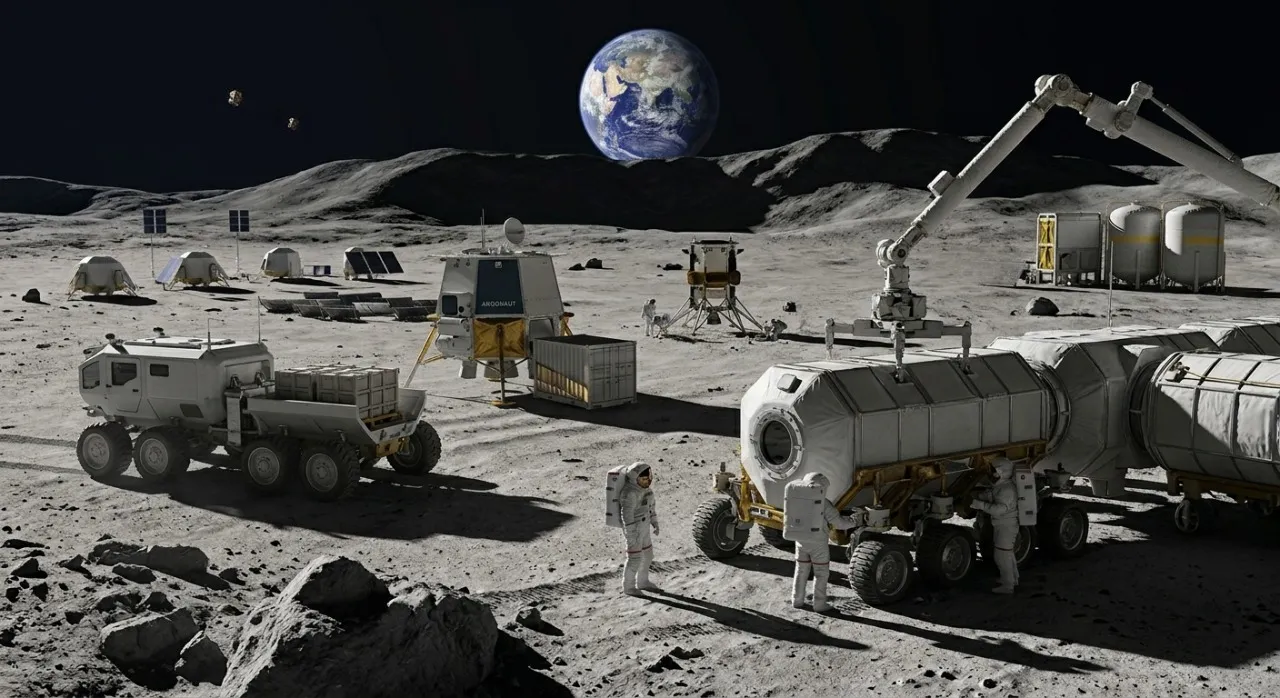
The perfect workplace if you are looking for peace, low gravity, and zero traffic, although the Earth in the background constantly reminds you of everything you're missing back home.
Deep space exploration has undergone a tectonic shift that redefines the rules of the geopolitical outer space chessboard. The restructuring of NASA's Artemis program, formalized in the first half of 2026, represents a strategic turning point by prioritizing the construction of a unified base lunar on the south pole of our satellite, at the expense of the orbital model supported by the Gateway space station. With an estimated investment of 20 billion dollars over the next seven years, this shift not only seeks to consolidate a distributed infrastructure on lunar soil, but also to respond firmly to competition from the International Lunar Research Station led by China and Russia. Facing the indefinite suspension of the Gateway, the European Space Agency —ESA— and its national partners confront the urgent task of renegotiating contracts and accelerating their own sovereign programs to avoid being left behind in the new interplanetary logistical ecosystem.
The industrial crossroads for Europe after the Gateway pause
NASA's decision to freeze the orbital station has disproportionately impacted European industry, the partner most exposed to the old microgravity architecture. Major contracts with giants like Thales Alenia Space and Airbus now face the risk of technological asset depreciation. Curiously, cutting-edge infrastructures like the International Habitation module Lunar I-Hab —awarded to Thales Alenia's Italian division for 327 million euros— and the Lunar View refueling module were designed to float in a vacuum and lack the structural supports needed to tolerate the Moon's partial gravity, additionally being vulnerable to abrasive lunar dust. Adapting these systems to support weight on the surface is like trying to place the foundations of a floating skyscraper onto a shifting desert. Furthermore, the confirmation of metallurgical corrosion issues in the Lunar I-Hab has led key providers like Redwire to study converting their berthing mechanisms for commercial missions in low Earth orbit.
This reconfiguration also clouds the future of the European Service Module, the energetic heart of the Orion crewed spacecraft manufactured by Airbus in Bremen. While the first three units were successfully delivered as a barter currency for managing the International Space Station, subsequent modules are governed by direct procurement contracts. Recent budget proposals from the US administration to scrap the SLS rocket after the Artemis V mission, replacing it with private commercial launchers, call into question the need to finish manufacturing advanced components like the ESM-6, despite ESA's efforts to maintain its validity.
New surface contracts and the drive for mobile habitation
Despite the orbital setback, Europe has managed to pivot toward firm ground through adapted commercial contracts and opportunistic scientific missions. NASA confirmed that the Moon Base III mission, operated through the Commercial Lunar Payload Services program, will integrate ESA scientific payloads alongside South Korean equipment to study lunar swirls using the Nova-C lander from the company Intuitive Machines. The objective is to analyze regolith behavior under the constant bombardment of solar wind.
The most mature project in the field of habitability is the Multi-Purpose Habitation Module, a strategic program funded by the Italian Space Agency in direct collaboration with NASA. Thales Alenia Space Italia leads the preliminary design of this pressurized habitat, conceived to house two astronauts during short stays. To maximize survival during the freezing lunar night, engineers incorporated a mobile traction system into the habitat, signing a contract with the US corporation Astrobotic to develop lightweight wheels based on flexible tension cables. This cooperative effort runs parallel to the deployment of terrain vehicles led by firms like Blue Origin, Astrolab, and Lunar Outpost, which will guarantee mobility and heavy supply transport in critical areas like the Shackleton Connecting Ridge.
The challenge for European crewed flights
The cancellation of the Gateway has completely blurred previous agreements for sending ESA astronauts into deep space. Traditionally, Europe secured three seats aboard the Orion spacecraft bound for lunar orbit as direct compensation for its technological contributions to the service modules. This contractual void contrasts with the position of the Japanese agency JAXA, which formally guaranteed the lunar landing of two of its astronauts thanks to the co-design of an expensive, long-range pressurized rover.
To correct this imbalance, ESA has called its member states to an extraordinary Council of Ministers to redefine its negotiating strategy with NASA. The goal is clear: exchange the lost orbital seats for real surface missions at the lunar base, leveraging the fact that the supply of Airbus power modules remains indispensable. Veteran and politically backed names like Thomas Pesquet, Tim Peake, Alexander Gerst, and Luca Parmitano emerge as the ideal candidates to step onto lunar dust under the European flag.
The sovereign bet: Argonaut, Moonlight, and regenerative cells
To balance the negotiating scale and move from technological subordination to cooperative interdependence, ESA has stepped on the gas regarding its independent flagship projects. The Argonaut program represents Europe's autonomous capacity to logistically access the Moon starting in 2030 using the Ariane 64 rocket. This medium logistical lander will be able to deposit up to 1,500 kilograms of supplies directly at the south pole. Its development is in the hands of a consortium led by Thales Alenia Space Italia under an 862 million euro contract, and includes the MANUS precision robotic arm, recently delivered by Redwire's subsidiary in Luxembourg.
In parallel, the Moonlight positioning and connectivity network, managed by Telespazio through a 123 million euro contract, will deploy a satellite constellation to provide the lunar base with high-speed navigation. This system, which will begin services with the precursor satellite Lunar Pathfinder, will function equivalently to a high-fidelity GPS network in space, allowing commercial rovers and landers to operate with lighter and cheaper navigation systems.
Finally, survival in an environment where the night lasts for two weeks and temperatures plunge to 150 degrees below zero required electrochemical innovation. ESA has developed a Regenerative Fuel Cell System that stores solar energy during the day by dissociating water into hydrogen and oxygen, only to recombine them at night, producing electricity and vital heat. This technology functions identically to a giant closed-circuit rechargeable battery that breathes water, doubling the energy density of the best lithium-ion batteries and guaranteeing Argonaut lander autonomy without relying on nuclear sources.
Toward a relationship of interdependence
NASA's radical shift toward the direct lunar base program has demonstrated the volatility of relying on political and budgetary swings in Washington. However, the simultaneous development of critical, sovereign infrastructures places Europe in a much more robust negotiating position. Thanks to the uninterrupted supply of Airbus power modules, the construction of the Italian habitat, and the deployment of the Argonaut transport and Moonlight telecommunications networks, ESA possesses strategic assets that NASA cannot easily do without. Europe thus leaves behind the role of a mere orbital companion to become an indispensable provider of habitability and logistics in the emerging economy of the lunar surface.