
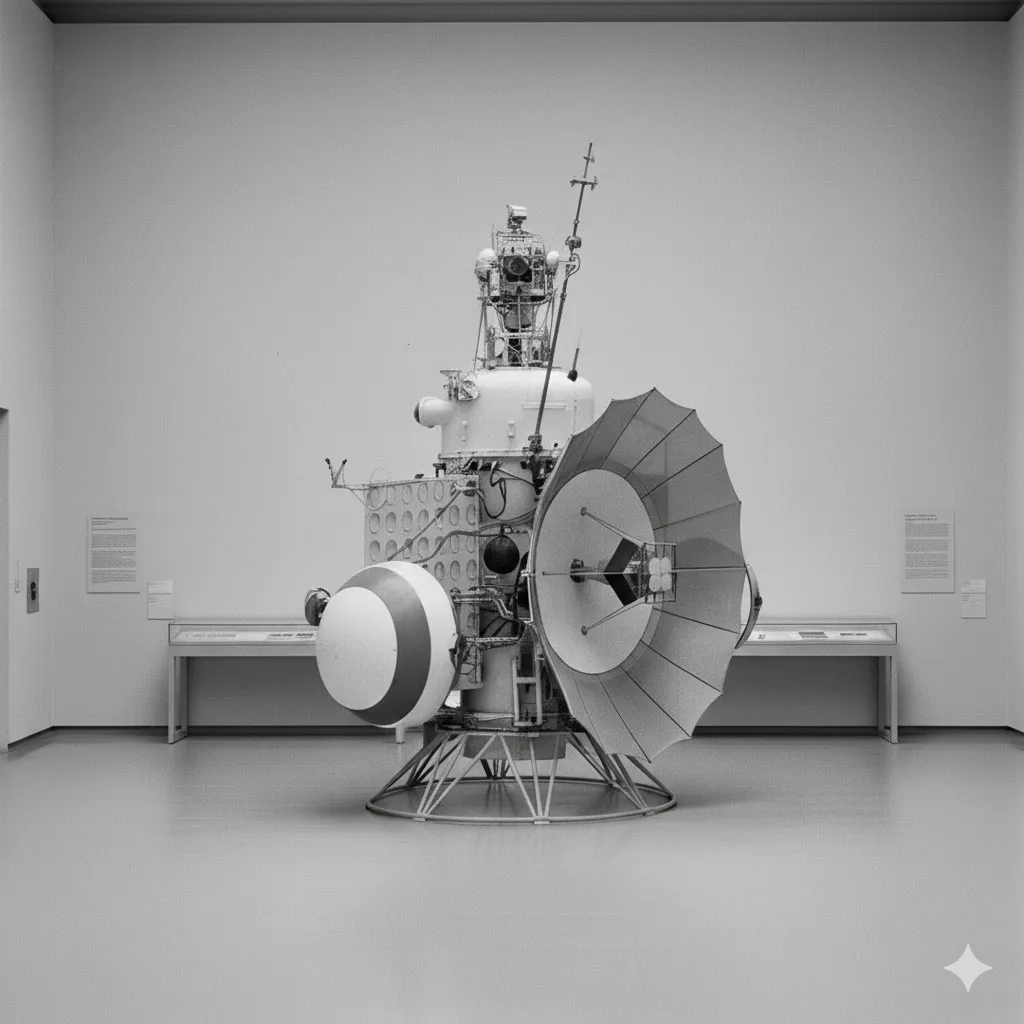
Mars 2MV-4 No.1 (Sputnik 22)
The Soviet mission Mars 2MV-4 No.1 (Sputnik 22), launched on October 24, 1962, failed in its attempt for a Mars flyby. Although it reached Earth orbit, the 'Blok L' escape stage exploded during the trans-Martian injection attempt, likely due to a lubricant leak in the turbopump.
Agency

Country

Type
Flyby
Status
Launch
October 24, 1962
Technical Analysis of the Mars 2MV-4 No.1 Mission (Sputnik 22)
- Mission Designation: Mars 2MV-4 No.1
- Internal Designation (USSR): Korabl 11
- Western Designation: Sputnik 22 (also Mars 1962A)
- Operating Agency: USSR Academy of Sciences (Design OKB-1)
- Launch Date: October 24, 1962, 17:55:04 UTC
- Launch Vehicle: Molniya 8K78
- Launch Site: Baikonur Cosmodrome, Site 1/5
1. Mission Objectives
The primary objective of the Mars 2MV-4 No.1 mission was to conduct a flyby of the planet Mars. It was the first Soviet attempt of the 1962 launch window, designed to validate the new 2MV interplanetary probe platform and gather scientific data during the transit and planetary encounter.
Specific Objectives:
- Test the second-generation unified interplanetary spacecraft platform (2MV).
- Obtain images of the Martian surface during the flyby.
- Study the interplanetary environment between Earth and Mars, measuring magnetic fields, cosmic radiation, and micrometeoroids.
- Search for a Martian magnetic field.
2. Probe Specifications (Mars 2MV-4 Platform)
This probe was a standardized modular design (Type 2MV) used for both Venus (2MV-1, 2MV-2) and Mars (2MV-3, 2MV-4) missions. Its specifications are presumed to be nearly identical to its sister ship, Mars 1 (2MV-4 No.2), launched days later.
- Total Mass: Approx. 894 kg
- Architecture: A cylindrical design, 3.3 meters long and 1 meter in diameter, hermetically sealed. It consisted of an "orbital module" (containing propulsion, guidance, and avionics) and an "experiment module" (housing the scientific payload).
- Attitude Control: Three-axis stabilization system oriented by sun sensors, star sensors, and gyroscopes.
- Power: Two large solar panels (total area 2.6 m²) charging cadmium-nickel batteries.
- Communications: A 1.7-meter parabolic high-gain antenna (HGA) for deep space communications, supplemented by omnidirectional low-gain antennas.
- Propulsion: A course-correction engine (KDU) based on liquid bipropellant.
3. Scientific Instrumentation (Presumed)
Based on the payload of its sister ship (Mars 1), the probe was expected to include:
- Imaging System: A television camera designed to photograph Mars.
- Magnetometer: Mounted on a boom to measure interplanetary and Martian magnetic fields.
- Radiation Sensors: Gas-discharge and scintillation counters to characterize cosmic rays.
- Micrometeoroid Detector: Piezoelectric sensors to measure the impact rate.
- Spectroreflectometer: To search for signs of organic matter (ozone absorption bands).
4. Launch Vehicle and Escape Stage
The mission used the Molniya 8K78 launcher, a 4-stage variant of the R-7 Semyorka.
- Stages 1, 2, and 3: The three-stage launcher performed correctly, delivering the payload and escape stage into a stable low Earth orbit (LEO).
- Stage 4 (Blok-L): A critical escape stage designed to ignite after a brief coast in LEO, providing the final thrust for trans-Martian injection (TMI) and escape from Earth's gravity.
5. Launch Failure Analysis
- Initial Sequence: The launch and ascent to low Earth orbit (LEO) were nominal.
- Failure Event (T+ ~60 min): During the coasting phase in LEO, prior to or during the planned ignition of the Blok-L stage's S1.5400 engine for trans-Martian injection, a catastrophic failure occurred.
- Root Cause: The Blok-L upper stage exploded. Subsequent investigation determined the most probable cause was a failure in the engine's rotating machinery. A lubricant leak in the turbopump of the main engine (S1.5400) caused it to overheat and seize.
- Failure Result: The seizure of the high-speed turbopump led to its disintegration and the subsequent explosion of the rocket stage.
- Impact: The Mars 2MV-4 No.1 probe and the Blok-L stage were destroyed, disintegrating into a cloud of debris in LEO. This debris was detected by the US space surveillance system (causing brief alarm, as this occurred at the height of the Cuban Missile Crisis). The fragments re-entered Earth's atmosphere over the following months.
6. Technical Conclusion
The Mars 2MV-4 No.1 mission was a launch failure. Although the initial stages of the Molniya rocket worked, a hardware failure (turbopump lubricant leak) in the Blok-L escape stage prevented the probe from ever leaving Earth orbit. The spacecraft was destroyed and never began its interplanetary journey. This failure highlighted the immaturity of restartable escape stage technology, a critical technical challenge for early interplanetary missions.
Mission Milestones
Launch
Sol 6 of Acidalo, Year 5