
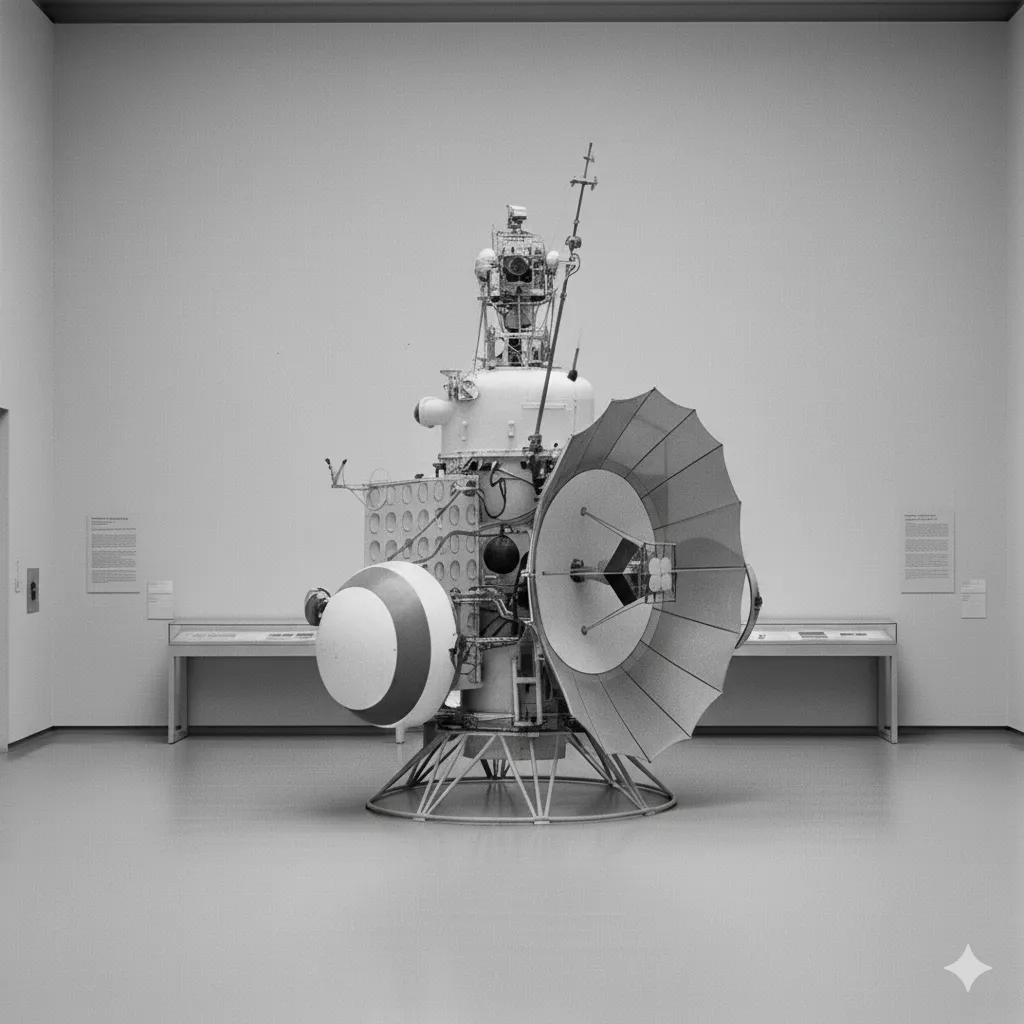
Mars 2MV-3 No.1 (Sputnik 24)
The Soviet Mars 2MV-3 No.1 (Sputnik 24) mission, launched on November 4, 1962, was an ambitious attempt at the first soft landing on Mars. Although the Molniya rocket reached Earth orbit, the Blok-L upper stage, damaged by severe vibrations during ascent, failed to ignite for trans-Mars injection. The craft remained stranded in orbit and disintegrated in the atmosphere.
Agency

Country

Type
Lander
Status
Launch
November 4, 1962
Technical Analysis of the Mars 2MV-3 No.1 Mission
- Mission Designation: Mars 2MV-3 No.1
- Western Designation: Sputnik 24
- Operating Agency: OKB-1 (for the USSR Academy of Sciences)
- Launch Date: November 4, 1962
- Launch Vehicle: Molniya 8K78 (Series L1-6M)
- Launch Site: Baikonur Cosmodrome, Site 1/5
1. Mission Objectives
Mars 2MV-3 No.1 was the first mission of the second generation of Soviet Mars probes (2MV), specifically designed as a lander. Its objectives were:
Engineering:
- Validate the 2MV spacecraft platform (orbital module and lander).
- Test the ignition of the escape stage (Blok-L) from a terrestrial parking orbit for trans-Mars injection (TMI).
- Execute the first deep-space trajectory correction maneuver (TCM).
- Test the atmospheric entry, descent, and landing (EDL) system on Mars.
Scientific:
- Achieve the first soft landing on the Martian surface.
- Transmit data on surface conditions (pressure, temperature).
- Measure radiation and magnetic fields during interplanetary cruise and on the surface.
2. Probe Specifications (Platform 2MV-3)
The spacecraft was a two-component design consisting of an orbital module (cruise stage) and a landing module (ALS - Automatic Landing Station).
- Total Mass: Approx. 890 kg
- Orbital Module (Cruise Stage): Acted as the carrier vehicle. It provided power (solar panels), attitude control (sun/star sensors, gas thrusters), communications, and the trajectory correction engine (KDU).
- Landing Module (ALS): A spherical capsule of ~1 meter in diameter. It contained the scientific instruments, communication system, and batteries. It was designed to separate from the orbital module before arrival and perform a direct atmospheric entry. The landing design likely combined a heat shield, a parachute, and a retrorocket or an impact-damping system.
3. Scientific Instrumentation (Planned for Lander)
The instrument package was focused on survival and basic surface analysis:
- Atmospheric Sensors: To measure pressure and temperature during descent and on the surface.
- Magnetometer: To search for a local magnetic field.
- Radiation Counter (Cosmic Ray Detector): To measure the radiation environment.
- Surface Instruments: Possibly a basic TV camera or a spectrometer (exact payload details for this failed mission are scarce).
4. Launch Vehicle and Escape Stage
The four-stage Molniya 8K78 launcher was used. This vehicle was necessary to send such a large mass beyond Earth orbit.
- Stages 1 & 2: Core configuration (Blok-A) and four boosters (Blok B, V, G, D) of the R-7.
- Stage 3 (Blok-I): An upper stage designed to operate in vacuum and insert the payload into the parking orbit.
- Stage 4 (Blok-L): The critical escape stage. Designed to ignite in LEO and provide the final impulse for trans-Mars injection.
5. Launch Failure Analysis
- Initial Sequence: The launch on November 4, 1962, proceeded nominally. Stages 1, 2, and 3 (Blok-I) functioned correctly, placing the Mars 2MV-3 No.1 probe and the Blok-L escape stage into the planned low Earth parking orbit (LEO).
- Failure Event: The Blok-L stage, which was supposed to ignite for trans-Mars injection, failed to start its engine.
- Root Cause: Post-flight analysis (based on telemetry from the sister mission failure, Sputnik 22) indicated that strong resonant longitudinal vibrations (Pogo oscillations) during the operation of the third stage (Blok-I) caused critical damage to the systems of the fourth stage (Blok-L).
- Failure Result: The damage prevented the ignition of the Blok-L engine. This could have been due to a failure in the turbopump control system, the pyrotechnic ignition system, or the guidance avionics.
- Orbital Decay: Unable to escape Earth's gravity, the spacecraft (now designated "Sputnik 24" by NORAD) was stranded in LEO. It disintegrated in Earth's atmosphere approximately two and a half months later, on January 19, 1963.
6. Technical Conclusion
The Mars 2MV-3 No.1 mission was a launch failure, specifically a failure of the escape stage. The mission failed to leave Earth orbit. The failure, along with that of the Sputnik 22 (Mars 2MV-4) flyby attempt just 11 days earlier, revealed a fundamental design flaw in the Molniya launcher (third-stage Pogo vibrations). This led to a redesign of the vehicle, but the 1962 launch window was entirely lost.
Mission Milestones
Launch
Sol 16 of Acidalo, Year 5