
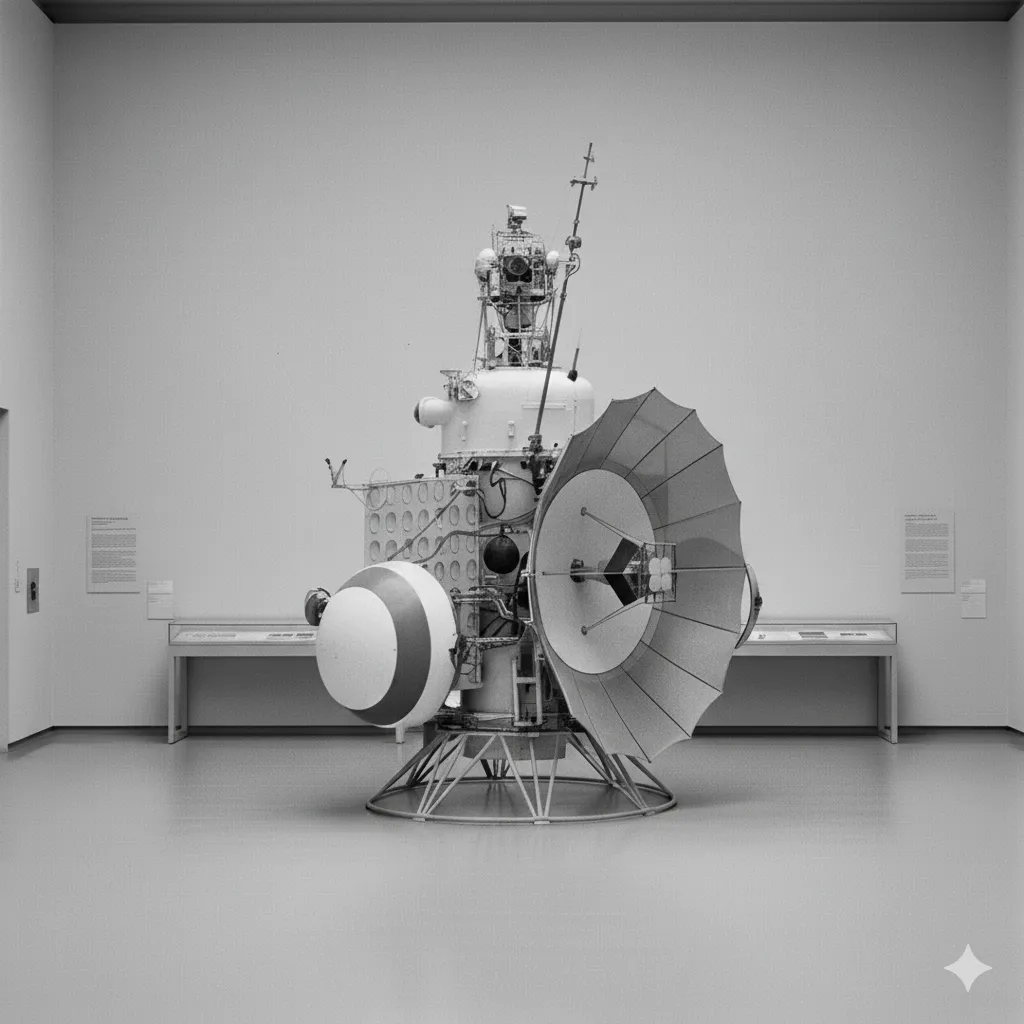
Zond 2
Zond 2 (1964) was a failed Soviet Mars flyby mission. A mechanical failure during rocket separation prevented one solar panel from deploying, cutting power by half. This led to thermal problems and the loss of communication in May 1965. It flew past Mars silently, but was the first spacecraft to test plasma thrusters in space.
Agency

Country

Type
Flyby
Status
Launch
November 30, 1964
Technical Analysis of the Zond 2 Mission
- Mission Designation: Zond 2
- Internal Designation (USSR): 3MV-4A No.2
- Operating Agency: USSR Academy of Sciences (Program managed by OKB-1)
- Launch Date: November 30, 1964
- Launch Vehicle: Molniya 8K78
- Launch Site: Baikonur Cosmodrome
1. Mission Objectives
The objectives of the Zond 2 mission were a combination of advanced engineering and planetary science:
Engineering:
- To test the second-generation interplanetary spacecraft platform (3MV-4A series) on a trajectory to Mars.
- To validate long-distance communication and thermal control systems.
- To test, for the first time in space exploration history, an electric propulsion system (pulsed plasma thrusters) as actuators for attitude control.
Scientific:
- To obtain images of the surface of Mars during the flyby.
- To study micrometeoroid flux.
- To measure interplanetary magnetic fields.
- To analyze solar wind and cosmic rays outside Earth's magnetosphere.
- To attempt to detect methane absorption bands in the Martian atmosphere.
2. Spacecraft Specifications (3MV-4A Platform)
Zond 2 was a 3MV-design probe, an evolution of the earlier Mars 1 probes.
- Total Mass: Approximately 890 kg.
- Architecture: The probe consisted of a pressurized cylindrical orbital module, which housed the avionics and electronics, and a scientific instrument module.
- Power: Two solar panels designed to deploy after separation from the rocket.
- Communications: A high-gain parabolic antenna (HGA) for deep space communications, supplemented by low-gain antennas (LGAs).
- Attitude Control: The primary system used cold nitrogen gas thrusters. As a technology demonstration, the probe was also equipped with six experimental pulsed plasma thrusters (PPTs), which served as a backup system.
3. Scientific Instrumentation
The scientific module carried a suite of instruments for the study of Mars and the interplanetary medium:
- Imaging System: A phototelevision camera with filters to photograph Mars during the flyby.
- Magnetometer: To measure the characteristics of the interplanetary magnetic field.
- Radiation Detectors: Scintillation and gas-discharge counters to measure cosmic and solar rays.
- Micrometeoroid Detectors: Piezoelectric sensors to measure particle flux.
- Ion Traps: To measure the characteristics of the solar wind.
- Infrared Spectrometer: Designed to search for methane signatures on Mars.
4. Launch Vehicle and Escape Stage
The mission used the Molniya 8K78 launcher, a 4-stage variant of the R-7 rocket.
- Stages 1 & 2: Core configuration (Blok A) and four side boosters (Blok B, V, G, D).
- Stage 3 (Blok-I): Ignited in the upper atmosphere to reach parking orbit.
- Stage 4 (Blok-L): An escape stage designed to ignite in Earth orbit and inject the probe onto the trans-Mars trajectory.
5. Analysis of Spacecraft Failure
The Zond 2 mission was a spacecraft failure due to a cascade of faults initiated immediately after a successful launch.
- Initial Failure Event: Following separation from the Blok-L upper stage, only one of the probe's two solar panels successfully deployed.
- Root Cause: Post-failure investigations determined the most likely cause was a mechanical failure. A "tug cord," designed to pull and deploy the solar panel, was damaged or severed during the separation maneuver of the Blok-L stage.
- Power Consequence: With only one operational solar panel, the spacecraft had only half of its intended electrical power.
- Technological Milestone: Despite the power deficit, on December 14, 1964, Soviet engineers successfully tested the six plasma thrusters (PPTs), marking the first use of electric propulsion in space.
- Thermal Failure and Loss of Contact: The power deficit and possible collateral damage during separation also compromised the thermal control system, leading to an "unsuited thermal condition". This combination of failures caused communications with the probe to degrade and be lost completely by May 1965.
6. Technical Conclusion
Zond 2 is considered a spacecraft failure. The mission was lost due to a mechanical failure in the deployment of one solar panel, attributed to damage during launcher separation. Although the resulting power loss and thermal problems doomed the mission before it reached Mars, the probe achieved the significant engineering milestone of successfully testing plasma thrusters in deep space. The probe flew silently past Mars on August 6, 1965.
Mission Milestones
Launch
Sol 10 of Deimo, Year 6
249 days
of travel
Arrival at Mars
Sol 29 of Luno, Year 6