Mariner 8
Mariner 8 (NASA), launched on May 9, 1971, was intended to be the first spacecraft to orbit Mars. However, the mission failed catastrophically during launch. The Centaur upper stage of the Atlas-Centaur rocket suffered an uncontrolled oscillation, leading to a premature engine shutdown. The spacecraft failed to reach orbit and fell into the Atlantic Ocean.
Agency

Country

Type
Orbiter
Status
Launch
May 9, 1971
Technical Analysis of the Mariner 8 (Mariner-H) Mission
- Mission Designation: Mariner 8
- Internal Designation (NASA): Mariner-H
- Operating Agency: NASA (Jet Propulsion Laboratory - JPL)
- Launch Date: May 9, 1971
- Launch Vehicle: Atlas-Centaur (SLV-3C)
- Launch Site: Cape Canaveral, Launch Complex 36B
1. Mission Objectives
The Mariner 8 mission, along with its twin spacecraft Mariner 9 (Mariner-I), constituted the 'Mariner Mars 71 Project'. Their primary objectives were to place two spacecraft into Martian orbit to conduct the most detailed exploration of the planet to date.
Primary Objectives (Combined project):
- Map at least 70% of the Martian surface with high resolution for a minimum of 90 days.
- Study the composition, temperature, density, and pressure of the Martian atmosphere.
- Analyze the composition and topography of the surface, including searching for temporal variations.
- Provide data for future missions, such as the Viking program.
Mariner 8 was specifically designed to enter a more inclined orbit to optimize mapping coverage.
2. Spacecraft Specifications (Mariner 71 Platform)
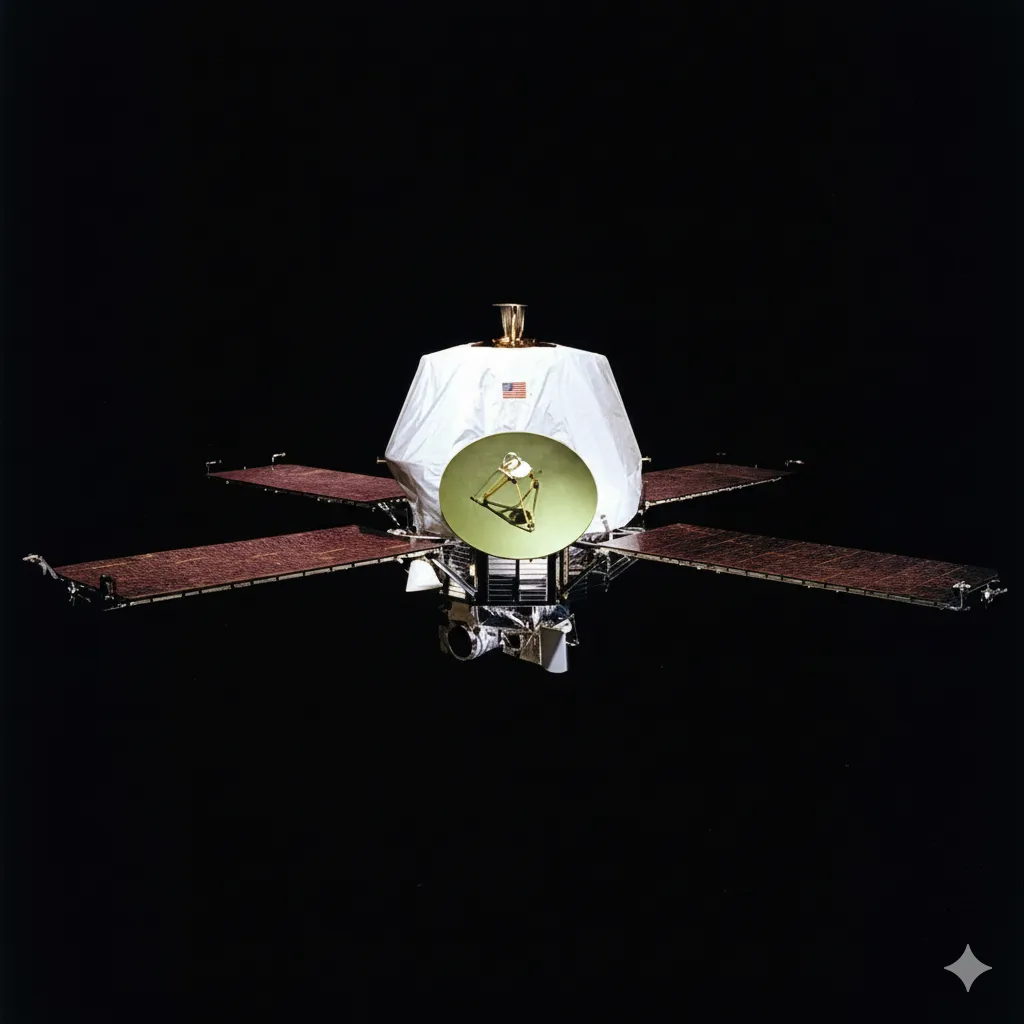
The Mariner 8 probe was identical in design to Mariner 9. It represented a significant evolution from the Mariner 6 and 7 missions.
- Total Mass: 997.9 kg (including 457.7 kg of propellant).
- Architecture: An octagonal magnesium frame (bus) (1.38 m diagonal) housing the electronics, propellant, and control systems.
- Power: Four solar panels extended from the bus, with a total wingspan of 6.89 m. They provided 800W at Earth and 500W at Mars, charging nickel-cadmium batteries.
- Attitude Control: Three-axis stabilization using solar sensors, a Canopus star tracker, and gyroscopes, actuated by 12 cold nitrogen gas thrusters.
- Main Propulsion: A 1,330 N thrust rocket engine (monomethylhydrazine and nitrogen tetroxide) for the Mars Orbit Insertion (MOI) maneuver.
- Communications: A 1 m diameter parabolic high-gain antenna (HGA) and an omnidirectional low-gain antenna (LGA) mounted on a mast.
3. Scientific Instrumentation
The scientific payload had a mass of 63.1 kg and was mounted on a movable scan platform. It included:
- Television Camera System (TV):
- Wide-Angle Camera (WA): Low resolution (approx. 1 km/pixel), wide field of view.
- Narrow-Angle Camera (NA): High resolution (approx. 100 m/pixel), for detailed observation.
- Infrared Radiometer (IRR): To measure surface temperatures and determine the thermal properties of the Martian soil.
- Ultraviolet Spectrometer (UVS): To analyze the composition and structure of the upper atmosphere, searching for hydrogen, oxygen, and ozone.
- Infrared Interferometer Spectrometer (IRIS): To measure atmospheric composition (water vapor, CO2) and surface mineralogy.
4. Launch Vehicle
The mission used the Atlas-Centaur (SLV-3C) launcher, a two-and-a-half-stage rocket designed for heavy interplanetary payloads.
- First Stage (Atlas SLV-3C): Used two main engines and one sustainer engine (all RP-1/LOX). The two main engines were jettisoned mid-ascent.
- Second Stage (Centaur D): A high-energy cryogenic upper stage (LH2/LOX), crucial for the trans-Mars injection. It was responsible for the final burn to escape Earth orbit.
5. Launch Failure Analysis
The Mariner 8 mission failed minutes after liftoff due to a failure in the Centaur upper stage.
- Initial Ascent: The launch occurred on May 9, 1971. The Atlas first stage performed nominally, separating as planned.
- Centaur Stage Ignition: The Centaur stage performed its main burn as scheduled to achieve a parking orbit.
- Failure Event (Approx. T+365 seconds): Shortly after the Centaur ignition, the stage's guidance system suffered a catastrophic anomaly. A severe oscillation or "pogo" was detected in the pitch control system.
- Failure Result: The oscillation rapidly grew beyond control limits. The destabilized guidance system commanded a premature shutdown of the Centaur engine.
- Impact: Lacking the necessary thrust to achieve orbital velocity, the Centaur vehicle and the Mariner 8 probe followed a ballistic trajectory. They re-entered the Earth's atmosphere and disintegrated, with debris falling into the Atlantic Ocean, about 560 km north of Puerto Rico.
6. Technical Conclusion
The Mariner 8 mission was a total launch failure[cite: 273]. The probe never reached Earth orbit nor had the chance to begin its interplanetary journey. The root cause was identified as a failure in the electronics of the Centaur stage's attitude control system. Following this failure, the objectives of the Mariner 8 mission were reassigned to and successfully completed by its twin, Mariner 9, which launched just 21 days later [cite: 95] and became the first spacecraft to orbit another planet[cite: 95].
Mission Milestones
Launch
Sol 33 of Marinero, Year 9