Mariner 9
NASA's Mariner 9 was the first probe to orbit another planet, arriving at Mars in November 1971. Although a global dust storm obscured the surface, the mission waited patiently. As the dust cleared, it revealed a new Mars: discovering Olympus Mons , Valles Marineris , and ancient riverbeds.
Agency

Country

Type
Orbiter
Status
Launch
May 30, 1971
Technical Analysis of the Mariner 9 Mission
- Mission Designation: Mariner 9 (Mariner Mars '71)
- Operating Agency: NASA (Jet Propulsion Laboratory - JPL)
- Launch Date: May 30, 1971 [cite: 95, 274]
- Launch Vehicle: Atlas-Centaur SLV-3C
- Launch Site: Cape Canaveral Air Force Station, Complex 36B
- Mars Arrival (Orbital Insertion): November 14, 1971
1. Mission Objectives
Mariner 9 was conceived, along with its failed twin Mariner 8[cite: 81], with ambitious scientific objectives that represented a quantum leap from previous flyby missions:
- Primary Objective: To become the first spacecraft to enter orbit around another planet.
- Secondary Objective (Scientific): To map at least 70% of the Martian surface at a significantly higher resolution than that obtained by the Mariner 4, 6, and 7 missions.
- Tertiary Objectives:
- Study the composition, density, pressure, and temperature of the Martian atmosphere.
- Analyze the composition, temperature, and topography of the surface.
- Obtain the first close-up images and study the characteristics of Mars's moons, Phobos and Deimos[cite: 101].
- Investigate the temporal dynamics of the planet, observing weather or atmospheric changes during its time in orbit.
2. Spacecraft Specifications
- Total Mass (Launch): 997.9 kg
- In-Orbit Mass (Post-insertion): 514.8 kg (after burning insertion propellant).
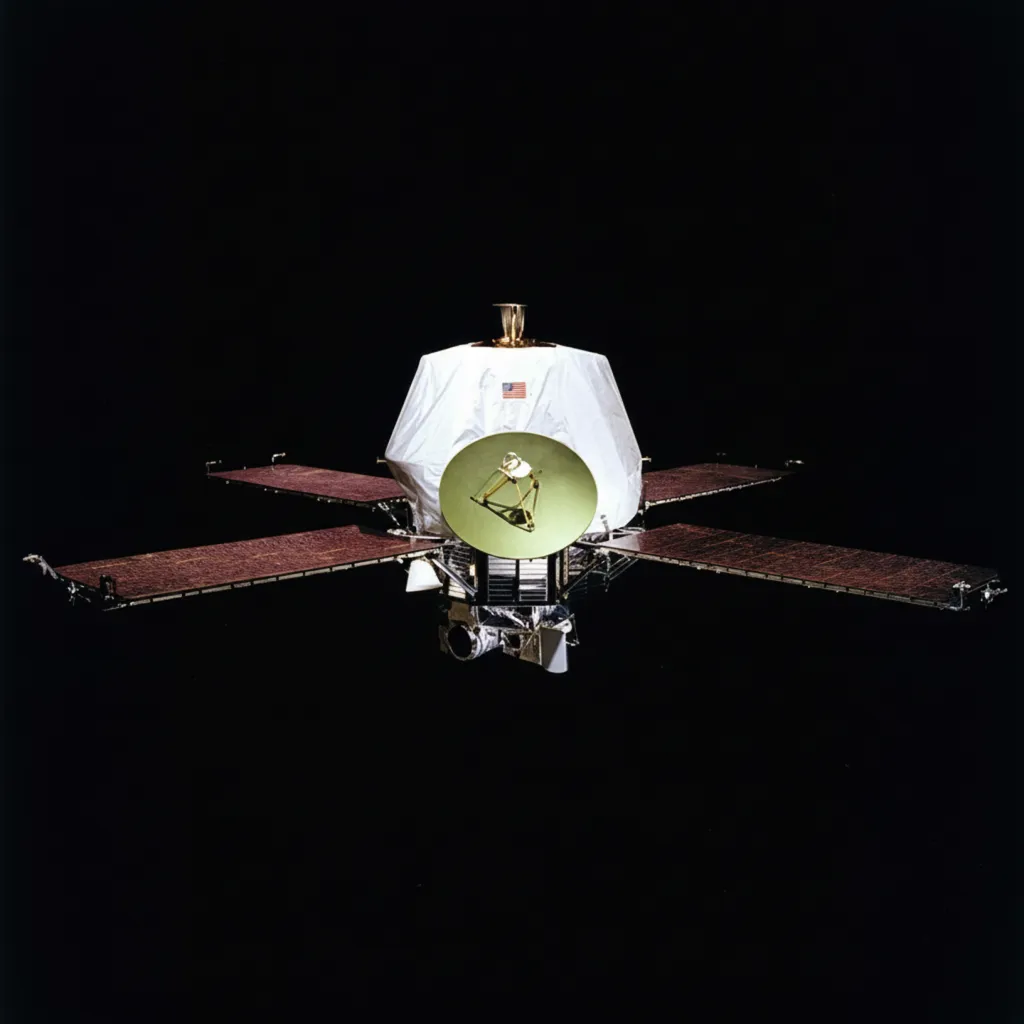
- Architecture: Octagonal magnesium frame, with four extended solar panels.
- Power: Four solar panels (1.57 m x 0.90 m each) providing 800W at Earth and 500W at Mars, charging nickel-cadmium batteries.
- Attitude Control: 3-axis stabilization system, using solar sensors, a star tracker (Canopus), and gyroscopes, with actuation via 12 cold nitrogen gas thrusters.
- Main Propulsion: Monopropellant (hydrazine) rocket engine with 1340 N of thrust, used for the Mars Orbital Insertion (MOI) maneuver.
- Communications: 1-meter diameter parabolic high-gain antenna (HGA) and an omnidirectional low-gain antenna (LGA).
3. Scientific Instrumentation
Mariner 9 carried a 63.1 kg payload with six main instruments:
- Television System (Cameras): Two Vidicon cameras:
- Camera A (Wide-Angle): Low resolution (11x14 degree field of view) for context mapping.
- Camera B (Narrow-Angle/Telephoto): High resolution (1.1x1.4 degree field of view) for surface details.
- Infrared Interferometer Spectrometer (IRIS): To measure atmospheric composition (water vapor), temperature profiles, and surface minerals.
- Infrared Radiometer (IRR): To determine surface temperatures and detect hot spots.
- Ultraviolet Spectrometer (UVS): To measure atmospheric composition and pressure, and ozone abundance.
- S-Band Occultation Experiment: Used the spacecraft's radio signal as it passed behind the planet to determine atmospheric pressure and density profiles.
- Celestial Mechanics Experiment: Used tracking of the spacecraft's telemetry to refine Mars's gravitational field and the mass of Phobos.
4. Launch Vehicle
The mission used the Atlas-Centaur (SLV-3C) launcher. This was a 2.5-stage vehicle:
- First Stage (Atlas SLV-3C): Powered by Rocketdyne MA-5 engines.
- Second Stage (Centaur-D): A high-performance cryogenic (LOX/LH2) upper stage, crucial for providing the necessary thrust for the trans-Mars injection.
- Mariner 8 Failure: The sister mission, Mariner 8, launched 21 days earlier (May 9, 1971), failed during launch when the Centaur upper stage experienced an uncontrolled oscillation and shut down, causing the payload to fall into the Atlantic[cite: 81]. Mariner 8's objectives (equatorial mapping) were reassigned and incorporated into Mariner 9's mission plan.
5. Mission Development and Results
Mariner 9 became the first spacecraft to successfully orbit another planet on November 14, 1971, beating the Soviet Mars 2 probe by only 13 days.
Waiting Out the Dust Storm
Upon arrival, Mariner 9 encountered a surprise: Mars was completely obscured by the largest global dust storm ever recorded. The only visible features were the summits of four enormous dark mountains, which would later be identified as the Tharsis volcanoes.
In a demonstration of operational adaptability, mission controllers at JPL made the critical decision not to initiate the primary mapping sequence and instead wait patiently for the storm to subside. The spacecraft was placed in a scientific "holding pattern," conserving resources as the storm raged for weeks.
A New Mars Revealed
As the dust began to settle over the following months, Mariner 9 began its mapping campaign[cite: 97]. What it revealed completely overturned the previous image of Mars as a cold, dead, Moon-like world established by Mariner 4[cite: 101].
During its 349 days in orbit, the mission was a resounding success. It mapped 85% of the planet's surface and transmitted 7,329 images.
6. Key Scientific Discoveries
Mariner 9's discoveries revolutionized planetary science:
- Giant Volcanism: Discovered the enormous shield volcanoes of the Tharsis region, including Olympus Mons, the largest known volcano in the solar system.
- Martian Tectonics: Identified Valles Marineris, a canyon system stretching over 4,000 km long, proving Mars had a geologically dynamic past.
- Evidence of Liquid Water: Provided the first clear photographic evidence of ancient riverbeds, deltas, and channels carved by liquid water on the surface.
- Study of the Moons: Captured the first close-up images of the moons Phobos and Deimos, revealing their irregular shapes and cratered surfaces[cite: 101].
- Atmospheric Data: Measured temperature and pressure profiles, and detected water vapor over the south polar cap.
7. Technical Conclusion
Mariner 9 exceeded all its primary objectives. It was not only an engineering triumph by achieving the first planetary orbital insertion, but its ability to patiently wait out the dust storm enabled a transformative scientific mission.
The mission demonstrated the invaluable worth of sustained orbital observation versus fleeting flybys, setting the standard method for future planetary exploration. The mission formally ended on October 27, 1972, after the spacecraft depleted its attitude control gas and batteries, and was shut down. Mariner 9 remains today as a derelict satellite in Mars orbit.
Mission Milestones
Launch
Sol 16 of Nilo, Year 9
167 days
of travel
Arrival at Mars
Sol 30 of Schiapo, Year 9
Operations Start
Sol 30 of Schiapo, Year 9
338 sols
of operations