Viking 2 Orbiter
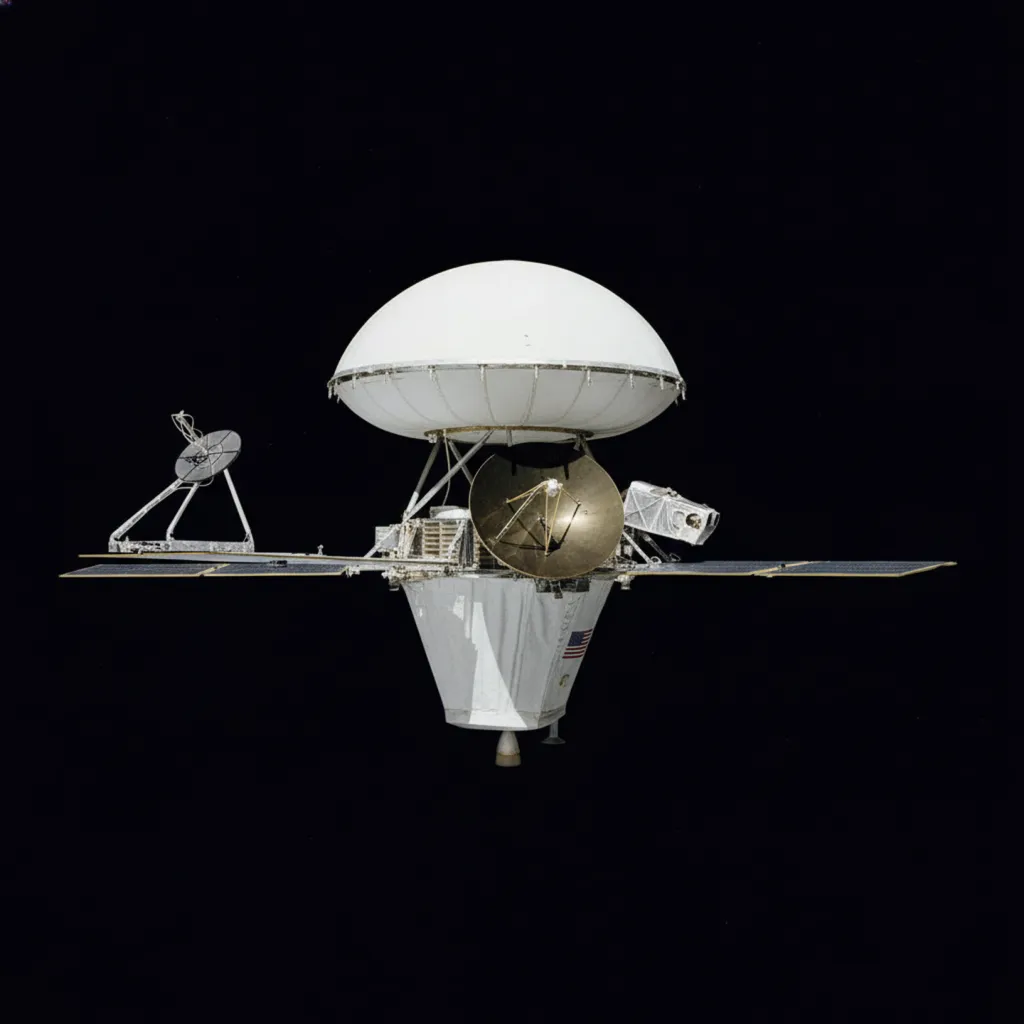
The Viking 2 Orbiter was inserted into Mars orbit on August 7, 1976. After deploying its lander, it operated independently conducting global, climatic, and atmospheric mapping. Its milestones include a close flyby of the moon Deimos and photographic confirmation of water ice at the north polar cap. The mission concluded on July 25, 1978, following a leak in its propulsion system.
Agency

Country

Type
Orbiter
Status
Launch
September 9, 1975
Technical Analysis of the Viking 2 Mission (Orbiter Component)
- Spacecraft Designation: Viking Orbiter 2
- Operating Agency: NASA (JPL / Langley Research Center)
- Launch Date: September 9, 1975, 18:39 UTC
- Orbital Insertion: August 7, 1976
- End of Mission: July 25, 1978
- Launch Vehicle: Titan IIIE-Centaur
- Launch Mass: 2,328 kg (Fueled)
- Dry Mass (Operational): ~900 kg (after Lander separation)
1. Mission Objectives (Orbital Segment)
The Viking 2 Orbiter had a distinct mission profile from its surface counterpart. Its primary objectives were:
- Interplanetary Transport: Carry the landing capsule (Viking Lander 2) to Mars orbit and certify the landing site at Utopia Planitia via reconnaissance imaging.
- Global Mapping: Obtain high-resolution images of the Martian surface for geological and cartographic studies.
- Atmospheric Study: Map the distribution and variability of atmospheric water vapor.
- Thermal Mapping: Analyze surface thermal inertia to deduce soil and rock composition.
- Moon Exploration: Perform close flybys of natural satellites, specifically Deimos.
- Communications Link: Act as a UHF data relay station for the Viking Lander 2.
2. Spacecraft Specifications (Orbital Bus)
The orbiter design was based on the successful Mariner 9 platform, adapted to support a heavier payload and long-duration operations.
- Structure: Octagonal magnesium and aluminum bus, 2.5 m in diameter. The structure housed 16 modular compartments for avionics.
- Power System: Four solar "wings" extending from the axis, with a total span of 9.75 m. Composed of 34,800 solar cells, they generated 620 W in Mars orbit. Power was stored in two 30-Ah nickel-cadmium batteries.
- Main Propulsion: A liquid bipropellant engine (Monomethylhydrazine and Nitrogen Tetroxide) capable of being gimbaled up to 9 degrees. It provided 1,323 N of thrust and a Delta-V of 1,480 m/s, essential for orbital insertion.
- Attitude Control: Three-axis stabilization using sun and star (Canopus) sensors, actuated by compressed nitrogen gas thrusters.
- Communications: 1.5 m high-gain parabolic antenna (S and X Band) steerable in two axes, plus a low-gain omnidirectional antenna.
3. Scientific Instrumentation (Scan Platform)
All scientific instruments were mounted on a steerable scan platform, allowing precise pointing at the surface or atmosphere without reorienting the entire spacecraft.
- VIS (Visual Imaging Subsystem): Two identical slow-scan vidicon cameras. Each had a 475 mm focal length telescope, with a field of view of 1.54° x 1.69°. Designed for visual mapping and geological studies.
- IRTM (Infrared Thermal Mapper): A multichannel radiometer designed to measure surface temperature, albedo, and atmospheric temperature at 0.5 millibar pressure levels. Critical for identifying physical soil properties (sand vs. rock).
- MAWD (Mars Atmospheric Water Detector): An infrared spectrometer specifically tuned to measure the abundance of water vapor in the atmospheric column.
- Radio Science System: Utilized the spacecraft's transmitters (S/X Band) for radio occultation experiments, allowing probing of the Martian atmosphere and ionosphere.
4. Failure Analysis/End of Mission
The Viking 2 Orbiter operated well beyond its 90-day design life. However, its end was precipitated by a mechanical failure:
- Event: Leak in the attitude control propulsion system.
- Consequence: The spacecraft began losing its nitrogen gas, vital for maintaining solar panel orientation towards the Sun.
- Final Action: On July 25, 1978, with gas nearly exhausted, controllers sent the shutdown command. The spacecraft was placed in a parking orbit of 302 x 33,176 km before being deactivated to prevent an immediate uncontrolled collision with Mars.
5. Specific Scientific Results of the Orbiter
The scientific legacy of the Viking 2 Orbiter includes critical discoveries independent of the lander's:
- North Pole Water: During October 1976, it acquired high-resolution images of the north polar cap, confirming for the first time that the residual cap was composed of water ice, not just carbon dioxide.
- Deimos Flyby: In October 1977, Viking 2 performed a historic close approach to the moon Deimos, coming within just 40 miles (64 km). Images revealed a cratered and irregular surface, supporting the captured asteroid theory.
- Water Vapor Cycle: The MAWD instrument mapped the global water cycle, discovering that the highest concentration of atmospheric water vapor occurs near the edge of the north polar cap during summer.
- Image Archive: Contributed approximately 16,000 images to the mission total, helping create the first detailed global map of Mars.
6. Technical Conclusion
The Viking 2 Orbiter was an exceptionally robust observation platform. Despite often being overshadowed by the success of its twin Viking 1 (which lasted longer), Orbiter 2 was instrumental in unlocking the secrets of the northern polar regions and the moon Deimos. Its ability to vary its orbit and coordinate with the lander demonstrated the efficacy of dual mission architectures. Its cessation of operations in 1978 marked the end of the first phase of continuous high-resolution orbital observation of Mars.
Mission Milestones
Launch
Sol 13 of Tharso, Year 11
332 days
of travel
Arrival at Mars
Sol 3 of Isido, Year 12
Operations Start
Sol 3 of Isido, Year 12
697 sols
of operations