
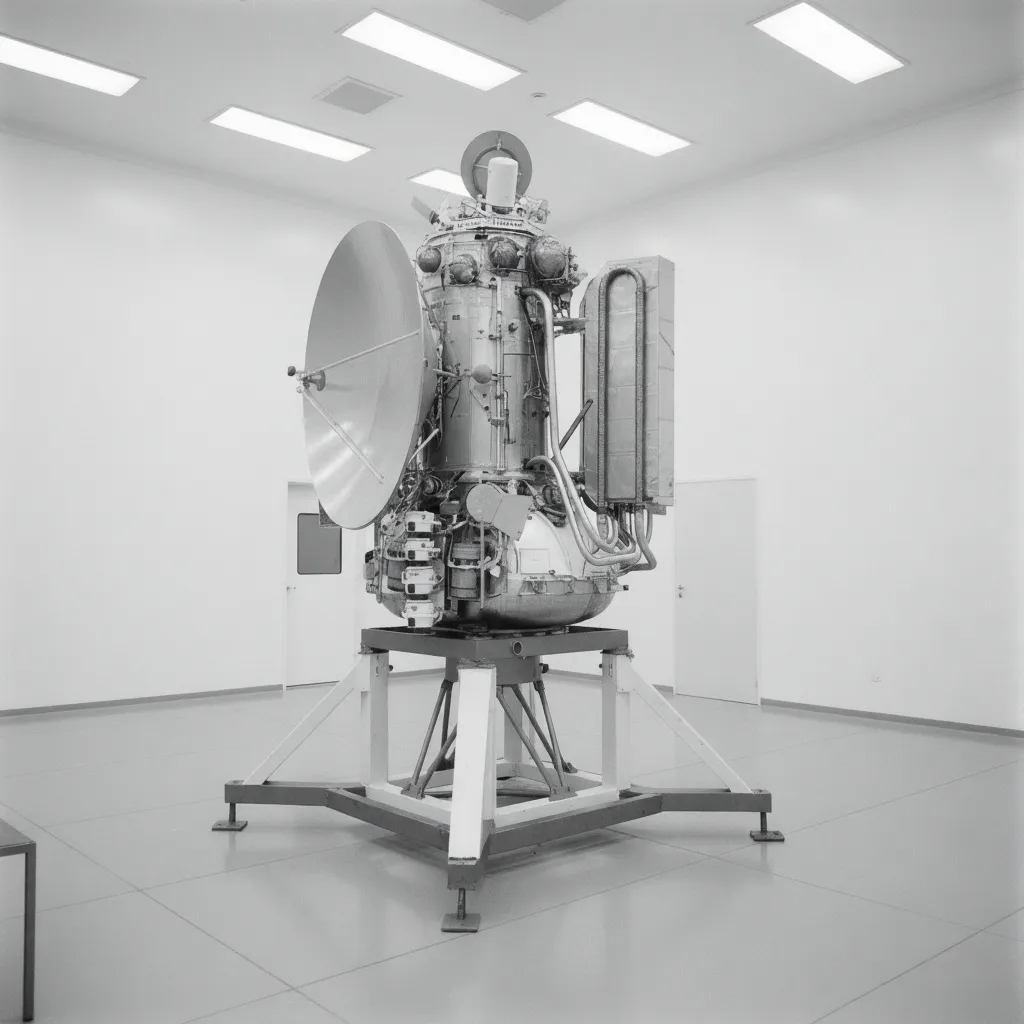
Mars 5
Launched by the USSR in 1973, Mars 5 was the only spacecraft of that window (Mars 4, 5, 6, 7) to successfully enter Mars orbit on February 12, 1974. However, a depressurization of the instrument compartment, likely due to a micrometeoroid, caused its failure after only 22 orbits and 16 days of operation, though it managed to return 43 high-quality images and surface data.
Agency

Country

Type
Orbiter
Status
Launch
July 25, 1973
Technical Analysis of the Mars 5 Mission
- Mission Designation: Mars 5
- Internal Designation (USSR): 3MS No.53S
- Operating Agency: Ministry of General Machine Building (MOM) / NPO Lavochkin
- Launch Date: July 25, 1973, 18:55:48 UTC
- Launch Vehicle: Proton-K / Blok D
- Launch Site: Baikonur Cosmodrome, Site 81/24
- Status: Orbital Insertion Success / Premature In-Orbit Failure
1. Mission Objectives
Mars 5 was the sister ship to Mars 4, launched with identical objectives to ensure redundancy. Its primary goals were:
Engineering and Operations:
- Achieve a stable insertion into Areocentric orbit (achieved, unlike Mars 4).
- Act as a data relay and link satellite for the Mars 6 and Mars 7 landers arriving weeks later.
Scientific:
- Perform a high-resolution photographic survey of the Martian surface for future landing sites.
- Measure surface chemical composition via gamma-ray spectrometry.
- Analyze the diurnal and nocturnal temperature profile of the Martian soil.
2. Spacecraft Specifications (3MS Platform)
The probe utilized the unified 3MS (M-73) platform, designed for long-duration orbiters.
- Launch Mass: 3,440 kg (fueled).
- Initial Orbit: Periapsis of 1,760 km, Apoapsis of 32,586 km, Inclination of 35.3 degrees.
- Power: Two lateral solar panels with a total area of 2.6 m² charging nickel-cadmium and silver-zinc batteries.
- Structure: Main cylindrical bus with a toroidal pressurized instrument compartment at the base, vital for maintaining operating temperature and pressure for avionics.
- Communications: Decimeter and centimeter band transmitters, utilizing a steerable high-gain parabolic antenna.
3. Scientific Instrumentation
Mars 5 carried a sophisticated payload for remote sensing:
- Cameras (Vega System): Included a 52mm camera (Vega), a 350mm telephoto (Zulfar), and a panoramic camera.
- Gamma-Ray Spectrometer: To measure radioactive elements (Uranium, Thorium, Potassium) in the regolith.
- Infrared Radiometer: Measured surface temperatures, recording maximums of -2°C and nighttime minimums of -73°C.
- Photometers and Polarimeters: Multiple units to study atmospheric light scattering and surface properties.
- Magnetometer and Plasma Traps: For studying the interaction of the solar wind with Mars' induced magnetosphere.
4. Failure Analysis and Results
Unlike its 1973 counterparts, Mars 5 completed its interplanetary voyage and correctly executed the braking burn on February 12, 1974.
- The Incident: Shortly after orbital insertion, telemetry indicated a loss of pressure in the main instrument compartment.
- Probable Cause: It is believed that a micrometeoroid impact during the insertion maneuver or immediately after punctured the pressurized hull.
- Consequences: The air leak caused electronics to operate outside their thermal and pressure parameters, leading rapidly to system failure. The spacecraft ceased all communication on February 28, 1974, operating for only 16 days (approximately 22 orbits).
- Mission Impact: Due to its premature death, Mars 5 could not serve as a relay for the Mars 6 and 7 landers that arrived in March 1974, contributing to the data loss from those missions.
- Scientific Achievements: In its short life, it transmitted 180 photographic frames, of which 43 were of usable quality, showing fluvial erosion and valleys south of Valles Marineris.
5. Technical Conclusion
Mars 5 was technically the only orbital insertion success of the disastrous 1973 Soviet launch window. Although it demonstrated that the 3MS platform could reach orbit (overcoming the Mars 4 failure), its lifespan was cut short by an external event (micrometeoroid) or sealing defect. The data obtained, especially images and temperature profiles, were valuable, but the loss of its relay capability was a critical blow to that year's Mars program.
Mission Milestones
Launch
Sol 3 of Ravo, Year 10
201 days
of travel
Arrival at Mars
Sol 13 of Acidalo, Year 11
Operations Start
Sol 13 of Acidalo, Year 11
15 sols
of operations