Mars 7
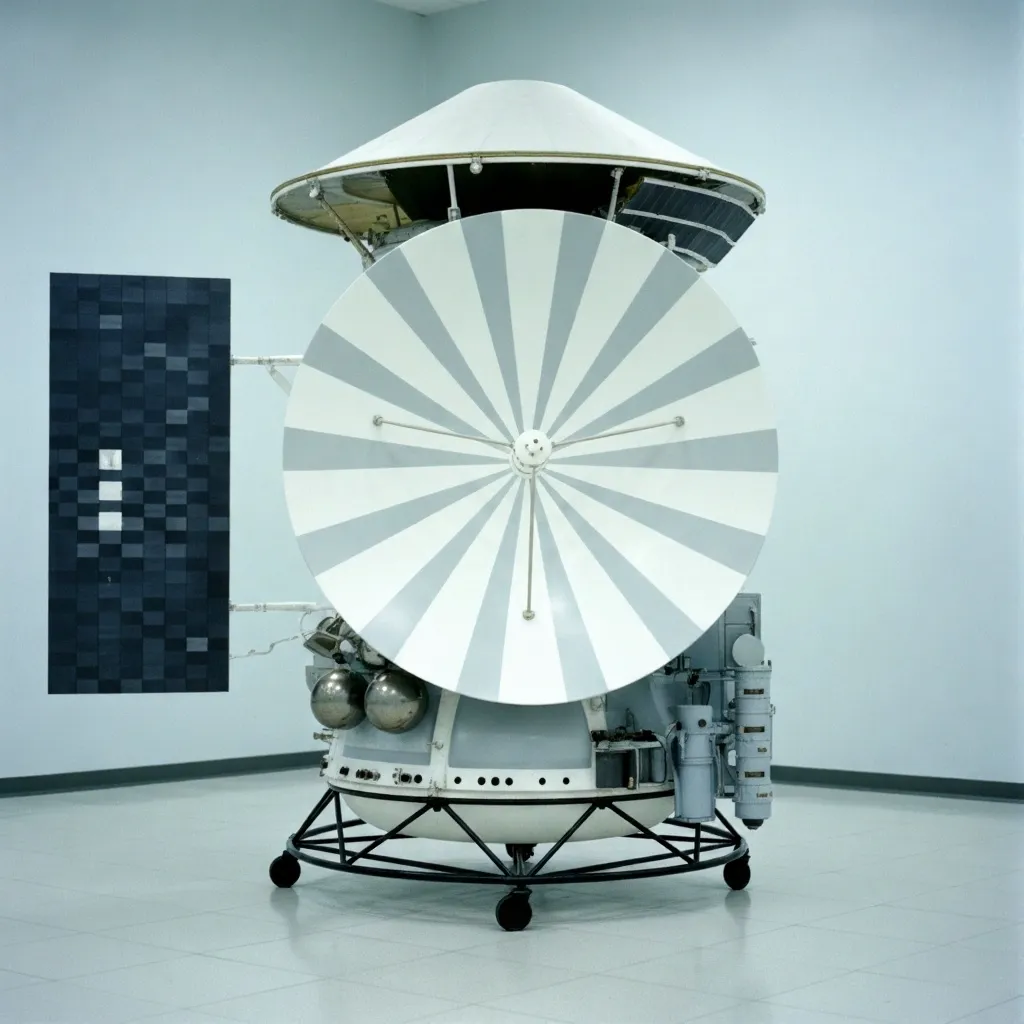
Launched on August 9, 1973, with the objective of performing a soft landing. Due to the degradation of onboard computer chips, the lander separated prematurely (or failed its correction maneuver) on March 9, 1974. The probe missed atmospheric entry and flew past the surface at a distance of 1,300 km, becoming trapped in a useless heliocentric orbit.
Agency
Country

Type
Orbiter
Status
Launch
August 9, 1973
Technical Analysis of the Mars 7 Mission
- Mission Designation: Mars 7
- Internal Designation (USSR): 3MP No.51P
- Operating Agency: Ministry of General Machine Building (MOM) / NPO Lavochkin
- Launch Date: August 9, 1973, 17:00:17 UTC
- Launch Vehicle: Proton-K / Blok D (8K82K)
- Launch Site: Baikonur Cosmodrome, Site 81/24
- Status: Mission Failure (Unintended Flyby)
1. Mission Objectives
Mars 7 was the final spacecraft of the 1973 Soviet armada, a twin to Mars 6. Its mission was the most complex of the launch window:
Engineering and Operations:
- Transport a lander module to the vicinity of Mars.
- Execute the separation of the module and perform a direct atmospheric entry for a soft landing.
- The flyby module (Bus) was to continue its trajectory to serve as a communications link with Earth.
Scientific:
- Study the composition of the Martian atmosphere and surface in situ.
- Measure physical parameters during descent (pressure, temperature, density).
- Analyze the plasma and radiation environment in interplanetary space and near Mars.
2. Spacecraft Specifications (3MP Platform)
The spacecraft utilized the 3MP configuration, optimized to carry a descent vehicle instead of fuel for orbital insertion.
- Launch Mass: 3,260 kg (Some sources cite higher figures including upper stages, but the standard 3MP probe mass is ~3.2t).
- Dimensions: Cylindrical bus ~2.8 m in height with two extendable solar panels.
- Lander Module: Spherical capsule of ~635 kg (similar to Mars 6) equipped with an aerodynamic heat shield and multi-stage parachute system.
- Propulsion: KTDU-425A main engine for mid-course corrections and nitrogen gas thrusters for attitude control.
3. Scientific Instrumentation
The payload was distributed between the cruise vehicle and the lander:
Flyby Bus (Coast Stage):
- Magnetometer: To study the planetary magnetic field.
- Plasma Traps and Cosmic Ray Detectors: To monitor solar wind and radiation.
- Micrometeoroid Detector: To measure interplanetary dust flux.
- Lyman-Alpha Photometer: To detect hydrogen in the upper atmosphere (cited in general series configurations).
Lander Module:
- Mass Spectrometer: For chemical analysis of the atmosphere.
- Environmental Sensors: Thermometer and barometer for surface conditions.
- Radio Altimeter and Accelerometer: Critical instruments for descent control.
4. Failure Analysis
The Mars 7 mission suffered a disappointing fate due to systemic failures in Soviet electronics of the era.
- Arrival at Mars: The spacecraft reached the vicinity of Mars on March 9, 1974, three days before its twin Mars 6 (launched earlier but on a different trajectory).
- The Separation Failure: Due to a malfunction in the onboard computer (likely corrosion in the chips or an error in the attitude control/retrorocket system), the lander separated prematurely or failed to execute the final correction maneuver necessary to intercept the atmosphere.
- Trajectory Result: Instead of entering the atmosphere, the lander flew past the planet at a minimum distance of 1,300 km from the surface.
- Root Cause: Subsequent investigations identified the use of transistors with aluminum components instead of gold, which corroded rapidly, as the primary cause of control system failure across the entire Mars M-73 series.
5. Technical Conclusion
Mars 7 was a total failure regarding its surface objectives. The inability to correct its trajectory or properly time the lander separation resulted in both the bus and the lander entering a permanent heliocentric orbit. This failure, combined with the problems of Mars 4, 5, and 6, marked the end of the Mars M-73 probe series and forced a complete re-evaluation of space electronics manufacturing standards in the Soviet Union.
Mission Milestones
Launch
Sol 17 of Ravo, Year 10
211 days
of travel
Arrival at Mars
Sol 37 of Acidalo, Year 11