Mars Express
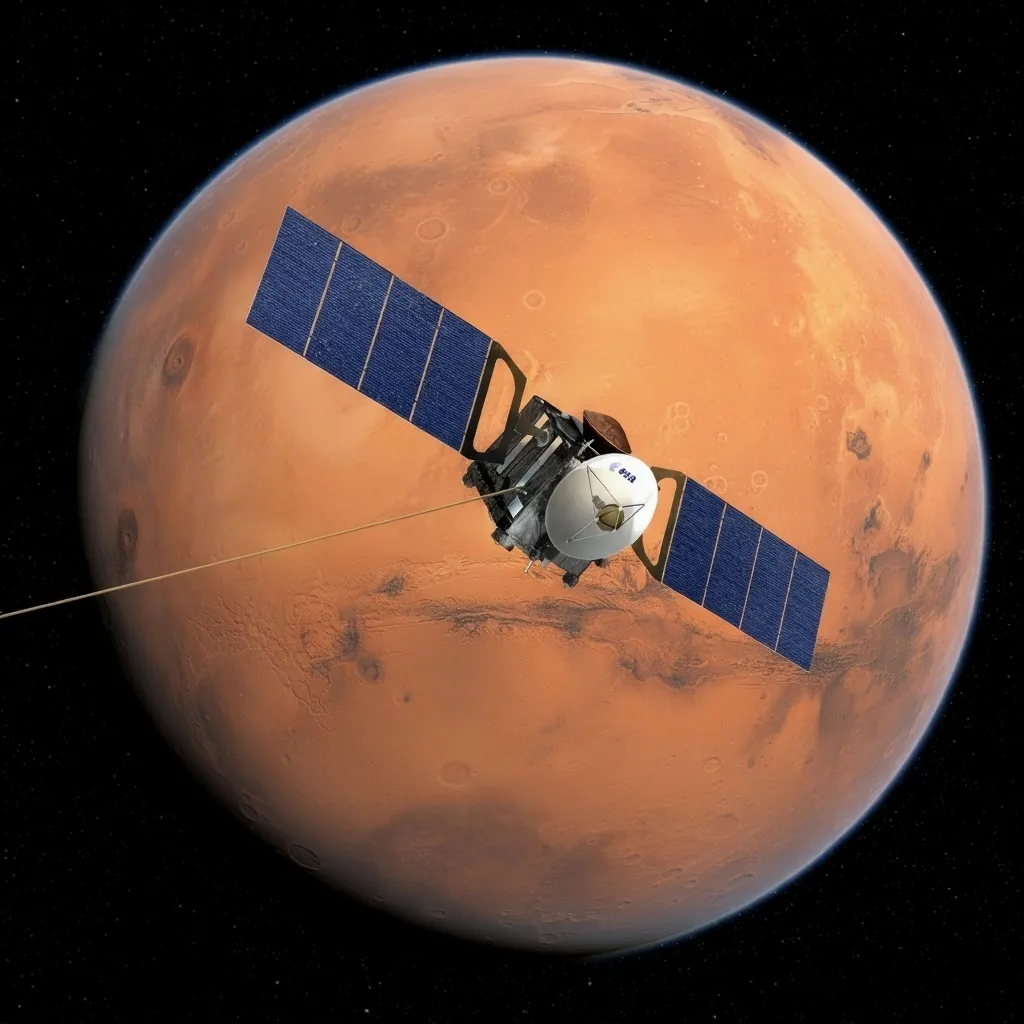
Launched in 2003 aboard a Soyuz-Fregat, Mars Express is ESA's first planetary mission. The orbiter achieved a successful insertion and has operated for over two decades. It has revolutionized our understanding of Mars by confirming subsurface water ice, detecting methane, and mapping hydrated minerals that prove a habitable past.
Agency

Country

Type
Orbiter
Status
Launch
June 2, 2003
Technical Analysis of the Mars Express Mission (Orbiter)
- Mission Designation: Mars Express
- Operating Agency: ESA (European Space Agency)
- Prime Contractor: Astrium (currently Airbus Defence and Space)
- Launch Date: June 2, 2003
- Launch Vehicle: Soyuz-FG / Fregat
- Launch Site: Baikonur Cosmodrome, Kazakhstan
- Orbital Insertion: December 25, 2003
- Status: Operational (Mission extended multiple times)
1. Mission Objectives
Mars Express, Europe's first interplanetary mission, was designed with global scientific objectives to study the atmosphere, surface, and subsurface of Mars with unprecedented resolution.
Scientific:
- Global Mapping: Obtain high-resolution images (10 m/pixel) of the surface and 3D topography.
- Mineralogy: Map the surface mineralogical composition to identify clays, sulfates, and carbonates associated with past liquid water.
- Subsurface Sounding: Search for liquid water or ice in the deep subsurface using radar.
- Atmosphere: Study global circulation, chemical composition (including trace gases like methane), and solar wind-induced atmospheric escape.
2. Spacecraft Specifications (Mars Express Bus)
The orbiter design relied on reusing existing architectures (Rosetta) to reduce costs and development time, a philosophy later used for Venus Express.
- Dimensions: Cubic structure of 1.5 m × 1.8 m × 1.4 m.
- Launch Mass: ~1,123 kg (including fuel and the Beagle 2 lander).
- Orbiter Mass (Dry): ~666 kg.
- Propulsion: 400 N main engine (bipropellant: monomethylhydrazine and nitrogen tetroxide) for orbital insertion, assisted by eight 10 N thrusters for attitude control and orbit corrections.
- Power: Two solar panel wings with a total area of 11.42 m², generating approximately 660 W at Mars. Storage via lithium-ion batteries.
- Communications: 1.6 m diameter High Gain Antenna (HGA) operating in X and S bands for telemetry and commands. Omnidirectional low-gain antennas for critical phases.
- Data Storage: Solid State Mass Memory (SSMM) with 12 Gigabit capacity.
3. Scientific Instrumentation
The orbiter carries a payload of seven main instruments, many inherited from the failed Russian Mars 96 mission:
- HRSC (High Resolution Stereo Camera): Stereo camera capable of generating color and 3D images with resolutions up to 2 meters in selected areas.
- OMEGA (Visible and Infrared Mineralogical Mapping Spectrometer): Spectrometer for mapping surface mineralogy (silicates, ices, carbonates). Crucial for detecting hydrated clays.
- MARSIS (Mars Advanced Radar for Subsurface and Ionosphere Sounding): Low-frequency radar with a 40-meter dipole antenna to penetrate the soil up to several kilometers searching for liquid water or ice.
- PFS (Planetary Fourier Spectrometer): Designed to measure atmospheric temperature and trace gas concentration, key in methane detection.
- SPICAM (Spectroscopy for Investigation of Characteristics of the Atmosphere of Mars): UV/IR spectrometer to analyze the atmosphere and detect ozone.
- ASPERA-3 (Analyzer of Space Plasmas and Energetic Atoms): Studies the interaction between the solar wind and the Martian atmosphere to understand long-term atmospheric erosion.
- MaRS (Mars Radio Science Experiment): Uses the spacecraft's radio signals to study the planet's gravity and ionosphere.
4. Launch Vehicle
The mission used a highly reliable medium-class Russian launcher operated by Starsem.
- Rocket: Soyuz-FG.
- Upper Stage: Fregat. This restartable stage was critical for placing the spacecraft into the interplanetary transfer trajectory towards Mars after reaching Earth parking orbit.
5. Mission Result and Achievements
Mars Express is one of ESA's greatest successes. Following a perfect orbital insertion on December 25, 2003, the spacecraft has exceeded its design lifespan (1 Martian year) by more than two decades.
Key Discoveries:
- Water at South Pole: The OMEGA instrument confirmed the presence of permanent water ice and CO2 at the south pole. Later, MARSIS detected strong radar reflections beneath the south polar ice, interpreted by some scientists as a subglacial liquid water lake.
- Methane Detection: The PFS instrument made one of the first orbital detections of methane in the Martian atmosphere, suggesting active geological or biological activity, though results remain scientifically debated.
- History of Water: OMEGA identified phyllosilicates (clays) that only form in the presence of neutral liquid water, demonstrating that Mars had habitable oceans or lakes in its remote past.
- Auroras: SPICAM detected the first mid-latitude auroras on Mars.
6. Technical Conclusion
The Mars Express orbiter demonstrated the viability of the "Faster, Better, Cheaper" approach applied by ESA, reusing hardware to minimize costs without sacrificing scientific return. Despite minor issues (such as the deployment failure of one MARSIS antenna boom which delayed its operation), the platform has shown exceptional robustness, becoming the second longest-lived spacecraft in Martian orbit after 2001 Mars Odyssey, and serving as a vital data relay for NASA surface missions.
Mission Milestones
Launch
Sol 28 of Nilo, Year 26
206 days
of travel
Arrival at Mars
Sol 5 of Utopo, Year 26
Operations Start
Sol 5 of Utopo, Year 26
7930 sols
of operations so far