Beagle 2
Beagle 2, an ambitious British lander launched in 2003 alongside Mars Express, aimed to search for chemical traces of life in Isidis Planitia. After landing on Christmas Day, complete silence followed. In 2015, orbital images revealed its cruel fate: it landed intact, but its solar panels failed to fully deploy, trapping its radio antenna and condemning the probe to eternal isolation.
Agency

Country

Type
Lander
Status
Launch
June 2, 2003
Technical Analysis of the Beagle 2 Mission
- Mission Designation: Beagle 2
- Operating Agency: UK-led Consortium (Open University, e2v, etc.) / ESA
- Carrier Spacecraft: Mars Express (ESA)
- Launch Date: June 2, 2003
- Landing Date: December 25, 2003
- Landing Site: Isidis Planitia (11.5°N, 90.4°E)
- Launch Vehicle: Soyuz-FG / Fregat
- Status: Successful landing visually confirmed (2015); Subsequent deployment failure.
1. Mission Objectives
Beagle 2 was a stationary lander designed with a specific focus on exobiology and low-cost geochemistry. Its primary objectives included:
Scientific:
- Search for Life: Detect signs of past or present life via carbon isotopic analysis in soil and rock samples.
- Atmospheric Analysis: Study the composition of the Martian atmosphere, looking for traces of methane and other biomarker gases.
- Geology: Characterize the mineralogy and chemistry of the landing site at Isidis Planitia, a sedimentary basin.
- Dating: Attempt absolute dating of rocks using the Potassium-Argon (K-Ar) method.
2. Probe Specifications
Beagle 2 was notable for its ultra-compact design and high payload-to-total-mass ratio.
- Total Launch Mass: ~69 kg (including entry system).
- Landed Mass: 33.2 kg.
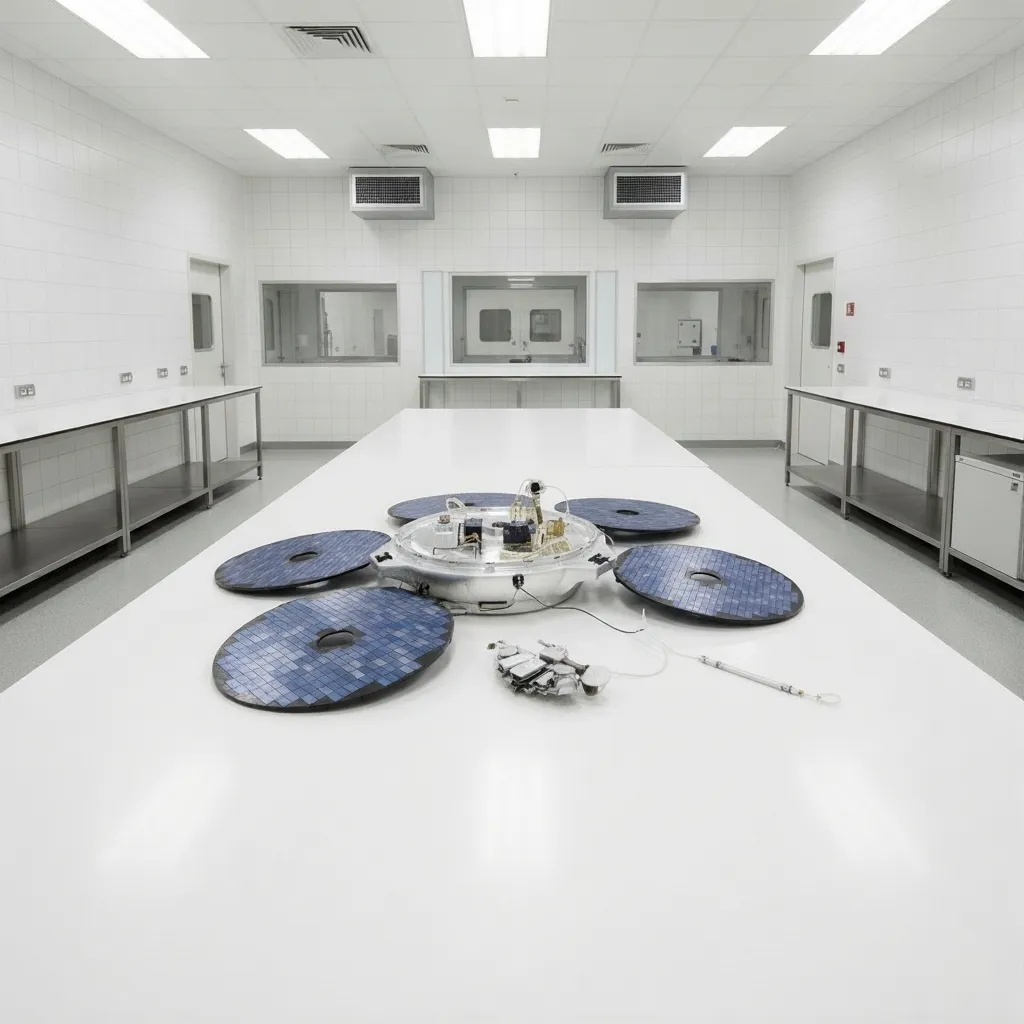
- Dimensions: "Pocket watch" shape. 66 cm diameter and 78 mm height (stowed). About 1.9 m span deployed.
- Thermal Management: Passive insulation and electric heaters.
- Power: Four petal-shaped deployable solar arrays plus a fixed central panel, charging Li-Ion batteries.
- Communications: UHF transceiver designed to communicate with Mars Express and Mars Odyssey. The antenna was located under the solar panels, requiring full deployment to function.
3. Scientific Instrumentation
Despite its small size, Beagle 2 carried a highly sophisticated payload (approx. 9 kg):
- GAP (Gas Analysis Package): A mass spectrometer to analyze carbon isotopes and atmospheric gases. It was the core instrument for the life search.
- PAW (Position Adjustable Workbench): A robotic arm carrying several instruments:
- Stereo Cameras: For panoramic and 3D imaging.
- Microscope: To examine rock textures at micrometric scale.
- Mössbauer Spectrometer (MIMOS II): For iron mineralogy.
- X-Ray Spectrometer (XRS): For elemental composition.
- PLUTO (Planetary Underground Tool): A mechanical "mole" designed to dig and retrieve subsurface samples (up to 1.5 m) for analysis in the GAP.
- Environmental Sensors: To measure UV radiation, temperature, pressure, and wind.
4. Mission Profile and Vehicle
Launched aboard a Soyuz-FG rocket with a Fregat upper stage, the probe traveled coupled to Mars Express.
- Separation: Beagle 2 was successfully released from Mars Express on December 19, 2003, on a controlled collision trajectory.
- EDL (Entry, Descent, and Landing): It utilized an ablative heat shield, a pilot parachute, a main parachute, and a gas-inflated airbag system to cushion the final impact on December 25, 2003.
5. Failure Analysis and Visual Recovery
- Loss of Signal: Following the scheduled landing, no signal was ever received. Mars Express and Mars Odyssey attempted to contact the probe without success. It was declared lost.
- Discovery (2015): Twelve years later, high-resolution images (HiRISE) from NASA's MRO orbiter identified the module in Isidis Planitia.
- Forensic Analysis: The images showed that Beagle 2 had survived entry and landed softly. The parachute and rear cover were found nearby.
- Root Cause of Silence: The images revealed that while the solar panels began to deploy, they did not fully open. It is estimated that only 2 or 3 of the 4 panels deployed. Due to the design, the communications antenna remained physically blocked under the undeployed fourth panel, preventing any data transmission.
6. Technical Conclusion
Beagle 2 was a partial engineering success, achieving a soft landing on Mars, a statistically difficult feat. However, it failed as a scientific mission due to a mechanical failure in the final deployment phase. The failure demonstrated the critical risks of "single point of failure" systems (the antenna under the panels) and the difficulty of fully validating complex deployment systems on Earth. Its legacy confirmed the viability of small, low-cost landers, though it underscored the need for redundant communication systems.
Mission Milestones
Launch
Sol 28 of Nilo, Year 26
206 days
of travel
Arrival at Mars
Sol 5 of Utopo, Year 26