Opportunity
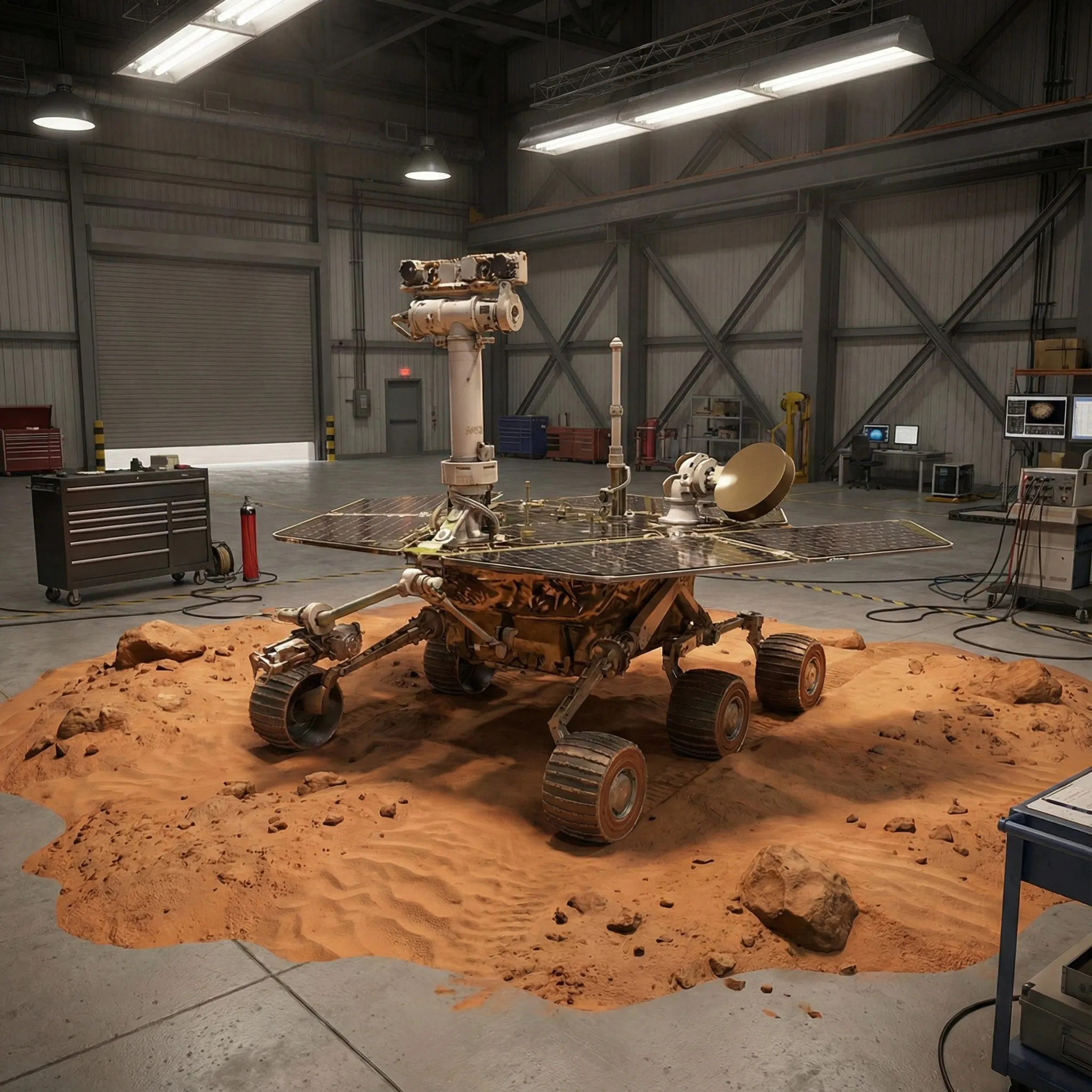
Launched on a Delta II Heavy in 2003, Opportunity (MER-B) landed on Meridiani Planum, Mars, in January 2004. Designed for 90 days, it operated for nearly 15 years, traversing 45.16 km (a record). It confirmed past liquid acidic water by discovering hematite and jarosite. A global dust storm in 2018 depleted its batteries, ending the mission in 2019.
Agency

Country

Type
Rover
Status
Launch
July 8, 2003
Technical Analysis of the Mars Exploration Rover-B (Opportunity) Mission
- Mission Designation: MER-B (Mars Exploration Rover - B)
- Rover Name: Opportunity
- Operating Agency: NASA / Jet Propulsion Laboratory (JPL)
- Launch Date: July 7, 2003 (03:18:15 UTC on July 8)
- Landing Date: January 25, 2004 (05:05 UTC)
- Launch Vehicle: Delta II 7925H (Heavy)
- Launch Site: Cape Canaveral, Space Launch Complex 17B (SLC-17B)
- Landing Site: Meridiani Planum (Eagle Crater)
- End of Mission: February 13, 2019 (Official declaration following loss of contact in June 2018)
1. Mission Objectives
The Opportunity mission was designed as part of the Mars Exploration Rover (MER) program with the primary goal of characterizing a wide variety of rocks and soils that might hold clues to past water activity on Mars. Its specific scientific objectives included:
- Geological Search: Determine the distribution and composition of minerals, rocks, and soils surrounding the landing site.
- Hydrological Investigation: Search for iron-containing minerals, specifically those formed in the presence of water (such as carbonates or sulfates), to verify hypotheses about a wet past.
- Orbital Validation: Calibrate and validate surface observations made by Mars Reconnaissance Orbiter (MRO) instruments from orbit.
- Habitability Assessment: Determine if the ancient environments present at Meridiani Planum were ever conducive to microbial life.
2. Spacecraft and Rover Specifications
The mission architecture was based on an entry, descent, and landing (EDL) system using airbags, similar to that of Mars Pathfinder, but carrying a much more capable mobile vehicle.
- Total Launch Mass: 1,063 kg (including cruise stage, aeroshell, and lander).
- Rover Mass: 185 kg.
- Rover Dimensions: 1.5 m height, 2.3 m width, and 1.6 m length.
- Power Generation: Triple-junction solar arrays (gallium arsenide) capable of generating up to 140 watts under optimal conditions, stored in two rechargeable lithium-ion batteries.
- Mobility: 6-wheel "Rocker-Bogie" suspension system, each with its own motor, designed to overcome obstacles up to 25 cm and 45-degree slopes. Theoretical top speed of 5 cm/s.
- Onboard Computer: 20 MHz RAD6000 CPU (based on IBM PowerPC architecture), radiation-hardened, with 128 MB of RAM and 256 MB of flash memory.
3. Scientific Instrumentation (Athena Payload)
The rover was equipped with the Athena science package, a suite of tools designed to act as a robotic field geologist:
Mast Instruments (PMA):
- Pancam (Panoramic Camera): Two high-resolution digital cameras with multispectral filter wheels to generate 3D color panoramas and perform visual mineralogy.
- Navcam (Navigation Camera): Wide-angle monochromatic cameras for trajectory planning.
- Mini-TES (Miniature Thermal Emission Spectrometer): Infrared instrument to identify mineral composition of rocks and soils from a distance.
Robotic Arm Instruments (IDD):
- Microscopic Imager (MI): A camera designed to simulate a geologist's hand lens, providing extreme resolution images (30 microns/pixel) of surface textures.
- Mössbauer Spectrometer (MB): Specifically designed to analyze the mineralogy of iron-rich rocks and soils.
- Alpha Particle X-Ray Spectrometer (APXS): To determine the elemental chemical composition of samples.
- RAT (Rock Abrasion Tool): A drill/grinder capable of removing weathered outer layers of rocks to expose fresh material for analysis.
4. Launch Vehicle: Delta II 7925H
Unlike its twin Spirit, which used a standard Delta II, Opportunity required the Delta II 7925H (Heavy) variant because its later launch window demanded higher characteristic energy (C3) to reach Mars.
- Solid Boosters: It used larger diameter (46 inches) GEM-46 motors instead of the standard GEM-40, providing significantly higher thrust at liftoff.
- Upper Stage: Star 48B solid propulsion motor (PAM-D) for trans-Mars injection.
- Performance: This configuration was crucial to place the spacecraft on the correct trajectory toward Meridiani Planum despite the orbital penalties of the launch date.
5. Mission Analysis and Results
Opportunity is considered one of the most successful interplanetary missions in history. Designed to last 90 days (sols), it operated for 14 years and 293 days (5,111 sols).
Key Milestones and Discoveries:
- "Hole in One" Landing: It landed fortuitously inside the small Eagle Crater, rolling to a stop in front of an exposed bedrock outcrop, allowing for immediate geological science.
- Proof of Past Liquid Water: It discovered iron-rich hematite concretions (nicknamed "blueberries") and jarosite deposits in Meridiani Planum. Jarosite is a mineral that only forms in the presence of acidic standing water, providing definitive proof that Mars had liquid water on its surface.
- Crater Exploration: After leaving Eagle, it explored Endurance Crater, Victoria Crater (where it spent two years), and finally the immense 22 km diameter Endeavour Crater.
- Distance Record: Opportunity holds the record for off-Earth driving, having traveled a total of 45.16 kilometers.
Loss of Spacecraft:
In June 2018, a massive global dust storm enveloped Mars. Atmospheric opacity (Tau) rose to unprecedented levels (>10.8), blocking nearly 100% of sunlight. Being a solar-powered rover, Opportunity lost the ability to recharge its batteries. Without power to run survival heaters, internal temperatures dropped critically, likely causing a "mission clock fault" and freeze damage to electronics. After over 1,000 recovery attempts, NASA declared the mission complete in February 2019.
6. Technical Conclusion
The MER-B Opportunity mission redefined the capabilities of robotic planetary surface exploration. Its extreme longevity allowed for the study of multiple Martian geological eras, transitioning from evidence of acidic water at its early sites to neutral pH water environments (more favorable for life) at Endeavour Crater (Matijevic formation). Technically, it demonstrated the robustness of solar power and long-term mobility in the harsh Martian environment, providing invaluable engineering lessons for subsequent rovers like Curiosity and Perseverance.
Mission Milestones
Launch
Sol 25 of Oppo, Year 26
201 days
of travel
Arrival at Mars
Sol 35 of Utopo, Year 26
Operations Start
Sol 35 of Utopo, Year 26
5350 sols
of operations