Perseverance
Perseverance landed in Jezero Crater in 2021 to search for ancient life and collect samples. It successfully deployed Ingenuity, the first helicopter on another world, and produced oxygen with MOXIE. It is the cornerstone of the future Mars Sample Return campaign.
Agency

Country

Type
Rover
Status
Launch
July 30, 2020
Technical Analysis of the Mars 2020 Mission (Perseverance)
- Mission Designation: Mars 2020
- Rover Name: Perseverance (Percy)
- Operating Agency: NASA / Jet Propulsion Laboratory (JPL)
- Launch Date: July 30, 2020, 11:50 UTC
- Launch Vehicle: Atlas V-541 (AV-088)
- Launch Site: Space Launch Complex 41 (SLC-41), Cape Canaveral
- Landing Date: February 18, 2021
- Landing Site: Jezero Crater, Mars
1. Mission Objectives
The Mars 2020 mission constitutes the first step in the international Mars Sample Return campaign. Its objectives are divided into four primary scientific pillars:
Scientific Exploration:
- Astrobiology: Search for signs of ancient microbial life in rocks formed in habitable environments.
- Geology: Characterize the geological evolution of Jezero Crater, an ancient river delta.
- Sample Collection: Drill and cache rock core and soil samples for future return to Earth.
- Human Preparation: Test technologies for future crewed exploration, specifically oxygen production.
2. Spacecraft Specifications (Mars 2020 Platform)
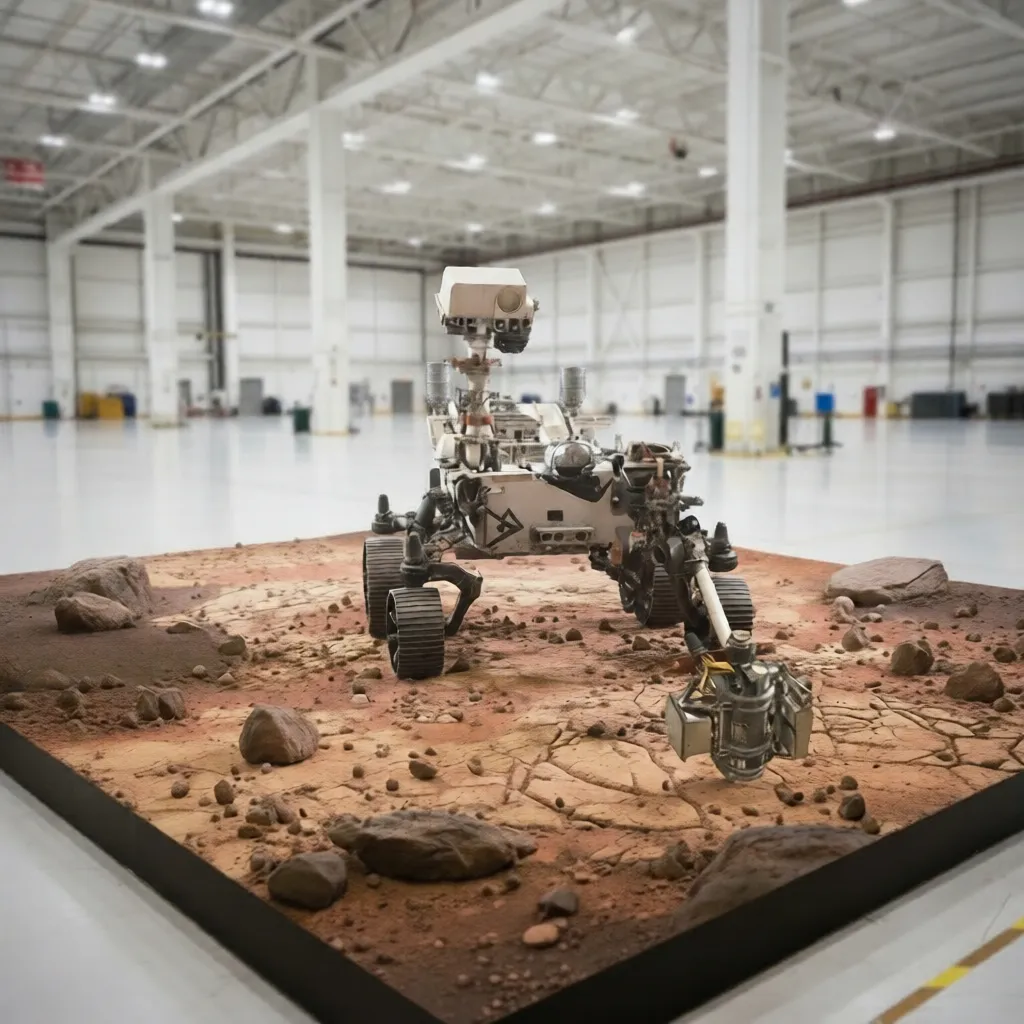
The design of Perseverance is based on the proven architecture of the Curiosity rover but with significant upgrades to its mobility system and sampling tools.
- Total Rover Mass: 1,025 kg
- Dimensions: 3 m long, 2.7 m wide, and 2.2 m high.
- Power System: Multi-Mission Radioisotope Thermoelectric Generator (MMRTG), utilizing heat from the decay of Plutonium-238 to generate 110 watts of electrical power.
- Mobility: Six aluminum wheels with more robust and narrower cleats than Curiosity's, designed to withstand wear from rugged terrain.
- Navigation: Enhanced AutoNav system for faster and more efficient autonomous driving.
3. Scientific Instrumentation
Perseverance carries the most advanced suite of instruments ever sent to the Martian surface:
- Mastcam-Z: Panoramic and stereoscopic camera system with zoom capability.
- SuperCam: Laser-based chemical and mineralogical analysis instrument using spectroscopy.
- PIXL: X-ray fluorescence spectrometer to determine elemental composition at a microscopic scale.
- SHERLOC: Raman and UV fluorescence spectrometer to detect organic matter and minerals.
- MOXIE: Technology demonstration to produce oxygen from CO2 in the Martian atmosphere.
- MEDA: Meteorological station measuring temperature, wind, pressure, and humidity.
- RIMFAX: Ground-penetrating radar to study subsurface geological structures.
4. Technology Demonstration: Ingenuity
The mission included the Ingenuity helicopter, a 1.8 kg technology demonstrator that achieved the first controlled, powered flight on another planet on April 19, 2021.
5. Landing Analysis (EDL)
- Atmospheric Entry: The capsule entered the atmosphere at 20,000 km/h, protected by a PICA-X heat shield.
- Terrain-Relative Navigation (TRN): A critical innovation that allowed the rover to compare real-time images with onboard maps to avoid hazards.
- Sky Crane System: After parachute braking, a rocket-powered aerial crane lowered the rover via nylon tether before detaching.
- Outcome: Successful landing with unprecedented precision, placing the rover in a safe zone within Jezero Crater.
6. Technical Conclusion
Mars 2020 represents the culmination of decades of robotic engineering. The success of Perseverance and the extended operation of Ingenuity have validated the use of aircraft on Mars and the capability of In-Situ Resource Utilization (ISRU). To date, the rover has successfully collected multiple samples containing evidence of ancient aqueous environments, ensuring the scientific value of the future Mars Sample Return mission.
Mission Milestones
Launch
Sol 36 of Phobo, Year 35
203 days
of travel
Arrival at Mars
Sol 11 of Acidalo, Year 36
Operations Start
Sol 11 of Acidalo, Year 36
1832 sols
of operations so far