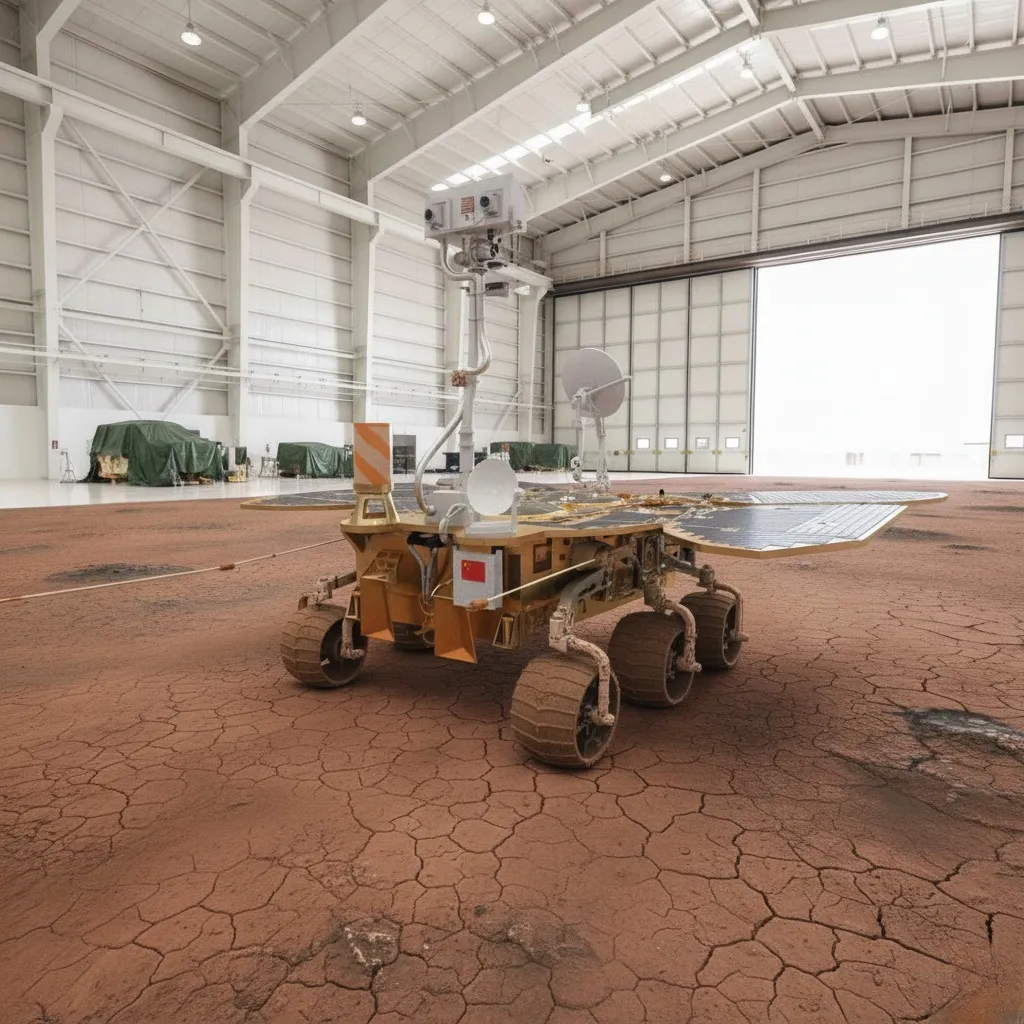
Zhurong
Zhurong successfully landed at Utopia Planitia in May 2021 following the launch of the Long March 5 rocket. China became the second nation to operate a rover on Mars, mapping the subsurface and studying regional climate before entering final hibernation in May 2022.
Agency
Country

Type
Rover
Status
Launch
July 23, 2020
Technical Analysis of the Zhurong Mission (Tianwen-1 Program)
- Mission Designation: Zhurong (Tianwen-1 Mission Rover)
- Operating Agency: China National Space Administration (CNSA)
- Launch Date: July 23, 2020
- Launch Vehicle: Long March 5
- Launch Site: Wenchang Spacecraft Launch Center
- Landing Date: May 14, 2021
- Landing Site: Utopia Planitia, Mars
- Mission Status: Completed (Entered hibernation in May 2022)
1. Mission Objectives
The Zhurong mission was the first independent robotic deployment on the Martian surface by China, operating under a coordinated multi-asset scheme with an orbiter:
Engineering:
- Execute a successful entry, descent, and landing sequence utilizing a heat shield, parachute, and retro-propulsion.
- Validate the autonomous operation and mobility capabilities of a rover within the unmapped terrain of Utopia Planitia.
- Demonstrate the efficiency of an interplanetary telecommunications system using the Tianwen-1 orbiter as a high-speed relay.
Scientific:
- Perform a detailed morphological and geological analysis of the Martian surface.
- Investigate subsurface structures using ground-penetrating radar to identify water-ice deposits or sedimentary layers.
- Monitor local magnetic fields and climatic conditions to understand regional atmospheric dynamics.
2. Spacecraft and Rover Specifications
The Zhurong rover was designed with a modular architecture to maximize thermal survival and energy efficiency.
- Mass: Approximately 240 kg.
- Power Configuration: Four high-efficiency solar panels with a foldable design to mitigate dust accumulation.
- Thermal Management: Use of aerogels and heating units to protect electronic components from temperature fluctuations.
- Mobility: Active suspension system on six wheels to overcome obstacles and navigate low-consistency terrain.
3. Scientific Instrumentation
The payload included state-of-the-art instruments for in-situ characterization:
- NaTeCam: Navigation and terrain cameras for stereo mapping.
- RoPeR: Dual-frequency subsurface penetrating radar for deep sounding.
- MarSCoDe: Composition detector based on laser-induced breakdown spectroscopy.
- MCS: Climate station for pressure, temperature, and wind measurements.
- RoMS: Surface magnetic field detector.
4. Launch Vehicle
The mission was placed into a trans-Martian injection trajectory using the Long March 5 rocket, the most powerful heavy-lift launcher in the Chinese space program. This vehicle's reliability allowed for the precise transport of the combined mass of the orbiter, lander, and rover.
5. Result Analysis
- Landing Success: A successful soft landing was achieved in May 2021, making China the second nation to operate a rover on Mars for an extended period.
- Surface Operation: The rover explored the Utopia Planitia plain, exceeding its initial operational life and returning data on subsurface stratigraphy.
- Mission Completion: The vehicle entered a hibernation state in May 2022 due to Martian winter conditions and dust accumulation on its solar arrays.
6. Technical Conclusion
Zhurong validated CNSA's technological maturity in complex interplanetary missions. The successful integration of an orbiter and a rover working in sync has laid the groundwork for future sample return missions, proving that China possesses the necessary capabilities for advanced solar system exploration.
Mission Milestones
Launch
Sol 29 of Phobo, Year 35
295 days
of travel
Arrival at Mars
Sol 19 of Deimo, Year 36
Operations Start
Sol 19 of Deimo, Year 36
1749 sols
of operations so far