What is the ESCAPADE Mission?
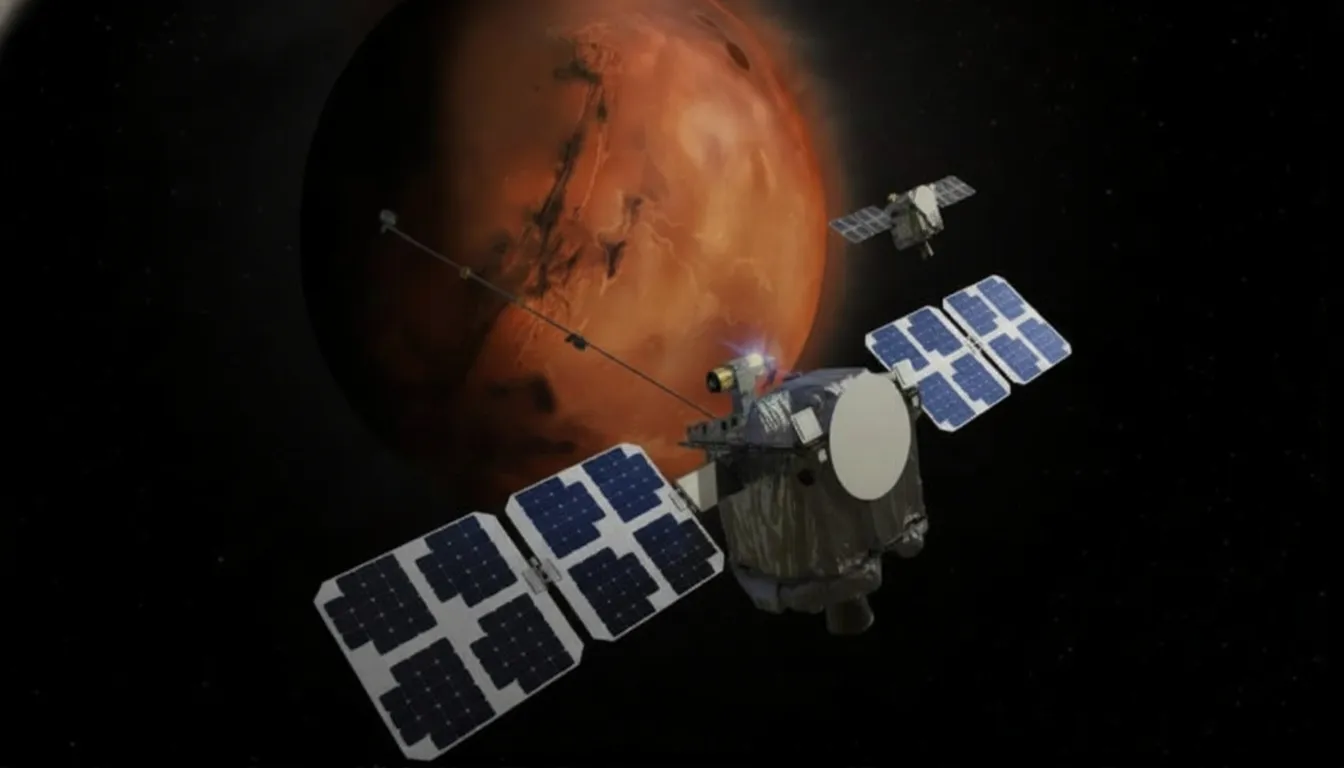
ESCAPADE is an orbital mission designed to perform the first simultaneous and coordinated measurements of Mars' magnetosphere. The name is an acronym for Escape and Plasma Acceleration and Dynamics Explorers.
- Main Objective: To study how the solar wind interacts with Mars' magnetosphere and drives the loss of its atmosphere.
- Spacecraft: Two identical orbiters named Blue and Gold.
- Launch Date: November 13, 2025.
- Launch Vehicle: Blue Origin's New Glenn rocket.
- Arrival at Mars: Scheduled for September 2027.
- Scientific Mission Duration: 11 months.
The Mystery of Mars' Lost Atmosphere
Billions of years ago, Mars was a radically different world. Geological evidence suggests it possessed a dense atmosphere, capable of maintaining liquid water on its surface in the form of rivers, lakes, and perhaps oceans. However, the loss of its global magnetic field about 4 billion years ago left the planet exposed to the relentless force of the solar wind, a supersonic flow of charged particles emanating from the Sun.
Without this protective shield, the Martian atmosphere was left vulnerable to erosion processes such as ion escape and sputtering. Over eons, these mechanisms stripped Mars of most of its atmosphere, transforming it into the cold and arid world it is today, with a surface pressure of barely 1% of Earth's.
Currently, the planet is not completely defenseless. It possesses a "hybrid" magnetosphere, a complex interaction between localized remnant magnetic fields embedded in its crust (the "crustal fields") and a weaker field induced by the interaction of the solar wind with its upper atmosphere. ESCAPADE is designed to measure and understand this unique system in detail and quantify current atmospheric escape rates to reconstruct the planet's climate history.
A Unique Strategy: Two Spacecraft for "Stereo" Vision
The most innovative feature of ESCAPADE is its strategy of using two spacecraft, making it the first orbital scientific mission with multiple coordinated spacecraft at Mars. This tactic solves a fundamental problem that has limited previous measurements: spatiotemporal ambiguity. Historically, a single spacecraft cannot distinguish if the changes it measures are due to a variation in time (the solar wind fluctuates) or in space (the spacecraft moves to another region). Terrestrial magnetospheric physics resolved this dilemma decades ago with multi-spacecraft missions, and ESCAPADE finally applies this proven approach at Mars.
The mission will be divided into two scientific campaigns to obtain a real-time, three-dimensional image of the Martian magnetosphere:
- Campaign A: "String of Pearls": During the first 6 months, the Blue and Gold spacecraft will follow the same highly elliptical orbit, with a periapsis (closest point) of 160 km and an apoapsis (farthest point) of 8,400 km. One spacecraft will follow the other with a variable temporal separation of up to 30 minutes. This configuration will allow measuring how conditions change in the same region of space over very short time intervals, revealing the dynamics of escape processes.
- Campaign B: "Complementary Orbits": During the following 5 months, the spacecraft will separate. Blue will raise its apoapsis to 10,000 km to monitor the incoming solar wind (the "cause"), while Gold will lower its to 7,000 km to observe the response of the Martian magnetosphere (the "effect") almost simultaneously. This will provide an unprecedented view of the cause-and-effect relationship in Mars' space weather.
A Different Journey to Mars: The Stop at the Lagrange Point
ESCAPADE's trajectory represents a paradigm shift in interplanetary logistics. Unlike traditional missions, which must launch within a strict window of a few weeks every 26 months to take advantage of the efficient Hohmann transfer, ESCAPADE launched when Earth and Mars were not aligned.
This flexibility is possible thanks to a low-energy route, a necessity imposed by the mass and propellant limitations of a low-cost spacecraft. A direct trajectory would have required more fuel than the spacecraft could carry to achieve orbital insertion at Mars. The innovative flight plan is as follows:
- The spacecraft travel first to the Sun-Earth Lagrange Point 2 (L2), a region 1.5 million kilometers from our planet where gravitational forces balance out.
- There, they will remain in a "loiter" orbit with a kidney bean shape for approximately one year, until November 2026.
- Once the planets reach the proper alignment, the spacecraft will return to Earth to use its gravity as a "slingshot," which will propel them toward the Red Planet.
- This maneuver initiates the final leg of the journey: a 10-month cruise culminating in arrival at Mars, completing a total journey of approximately 22 months.
This strategy is a crucial precedent for the logistics of future human missions. It demonstrates that "fleets of spacecraft" can be sent launching over months, waiting at L2, and departing together for Mars, solving the bottleneck of strict launch windows.
A New Era of Exploration: Low-Cost Science and High Collaboration
ESCAPADE is a paradigmatic example of a new way of doing planetary exploration. The mission is part of NASA's SIMPLEx (Small Innovative Missions for Planetary Exploration) program, which funds innovative low-cost projects (less than 80 million dollars) with higher risk tolerance. Its budget contrasts drastically with the 583 million dollars of the MAVEN mission, which studied similar topics.
The use of two identical spacecraft provides "external redundancy": if one spacecraft were to fail, the other could still fulfill the main scientific objectives, acting as an insurance policy. This model is possible thanks to close collaboration between academia, government, and private industry.
| Role in Mission | Principal Organization |
|---|---|
| Scientific Direction and Leadership | University of California, Berkeley (SSL) |
| Spacecraft Construction | Rocket Lab |
| Launch Service | Blue Origin |
| Trajectory Design | Advanced Space LLC |
| Scientific Instruments | NASA Goddard, Embry-Riddle, U. of Arizona |
Scientific Instrumentation
Each spacecraft carries an identical suite of instruments to measure particles and fields:
- EMAG (Magnetometer): Measures the magnetic field to map the structure of the hybrid magnetosphere.
- EESA (Electrostatic Analyzer): Measures the energy and direction of ions and electrons from the solar wind and the escaping atmosphere.
- ELP (Langmuir Probe): Measures the density and temperature of cold plasma in the Martian ionosphere.
- VISIONS (Visible/Infrared Observation System): Cameras to detect Martian aurora and monitor the spacecraft's thermal performance.
Launch and Next Steps
The ESCAPADE mission launched successfully on November 13, 2025, from Cape Canaveral Space Force Station, Florida.
A previous launch attempt on November 12 had to be postponed due to a severe geomagnetic storm (G4 level). This event poignantly underscored the importance of studying the space weather that the mission itself will investigate to protect future technologies and astronauts on Mars.
The future schedule of the mission is as follows:
- November 2025 - November 2026: "Loiter" phase in orbit at the L2 point.
- September 2027: Arrival and insertion into Mars orbit.
- Mid-2028: Start of the 11-month scientific mission.
Conclusion: Solving Mars' Past to Protect Its Future
ESCAPADE represents much more than a mission to study Mars' atmosphere. Its data will not only help us reconstruct the Red Planet's climate history, but will also be crucial for planning the safety of future crewed missions, by allowing us to better predict Martian space weather. ESCAPADE will not only rewrite Mars' climate history, but is validating an exploration model—collaborative, affordable, and logistically revolutionary—that will define the next era of our expansion into the solar system.