What is the ExoMars Rosalind Franklin Mission?
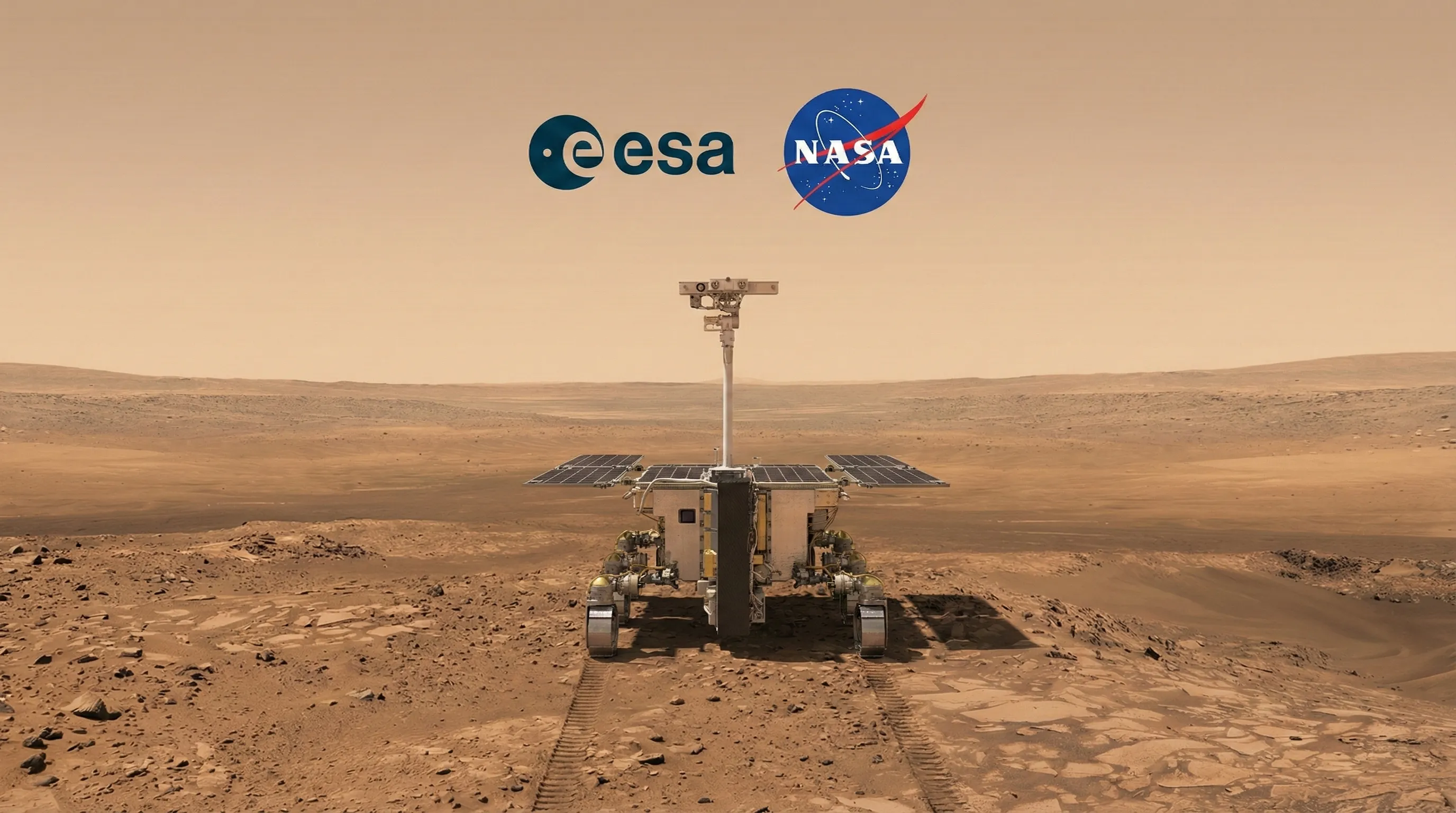
The Rosalind Franklin mission is Europe's most ambitious bet for planetary exploration. Unlike other robots already traversing Mars, this rover seeks not just habitability, but direct biosignatures: physical or chemical proof that life existed on the Red Planet billions of years ago. It is a project of technological resurrection that, after severing ties with Russia, now flies under the European flag with critical support from the United States.
- Main Objective: To drill into the deep subsurface to find traces of past life protected from radiation.
- The Rover: A 6-wheeled autonomous vehicle capable of "walking" over difficult dunes.
- Launch Date: Late 2028.
- Mars Arrival: Scheduled for 2030 (avoiding the dust storm season).
- Landing Site: Oxia Planum, an ancient plain rich in clays and past water.
- The Big Difference: It is the only rover capable of drilling up to 2 meters (6.5 feet) deep.
A Survival Story: ESA's "Phoenix"
The history of this rover is worthy of a suspense movie. Originally designed to launch years ago, the project was caught in the crossfire of global geopolitics. Following the break in cooperation with the Russian agency Roscosmos in 2022 due to the war in Ukraine, the rover (which was already built) was left "stranded" on Earth, without a rocket and without a landing platform.
It seemed like the end, but Europe decided not to give up. In a massive industrial rescue operation confirmed this November 2025 at the "CM25" Ministerial Council, the entire mission has been redesigned. Russian components have been replaced with Western technology: we will now land with a platform manufactured in the United Kingdom, braking engines from NASA, and a completely new onboard computer.
The Secret Weapon: Why Drill 2 Meters?
The surface of Mars is a hostile place. Cosmic radiation constantly bombards the ground, destroying any complex organic molecules (the "building blocks" of life) that might be there. That is why scratching the surface as other rovers do might not be enough.
Rosalind Franklin has a unique tactical advantage: its drill. By penetrating two meters underground, the rover accesses a "time capsule" protected from radiation and corrosive surface oxidants. It is there, in the darkness of the subsurface, where scientists believe that evidence of life from 4 billion years ago could be waiting intact.
International Collaboration and Task Division
For the rover to arrive safely at Oxia Planum in 2030, a global effort has been necessary. While Europe provides the science and the structure, NASA brings the "brute force" to leave Earth and brake at Mars. The signed agreement ensures that the United States will provide the launch rocket and the "nuclear heaters" (RHUs) needed so the rover does not freeze during the frigid Martian nights.
| Component / Role | Primary Responsibility |
|---|---|
| Leadership and Rover | Thales Alenia Space (Italy) |
| New Landing Platform | Airbus Defence and Space (UK) |
| Heat Shield (Atmospheric Entry) | ArianeGroup (France) |
| Descent Engines and Heaters | NASA (United States) |
| "Eyes" Instrument (Enfys) | Aberystwyth University (UK) |
Scientific Instruments: A Laboratory on Wheels
The rover doesn't just drill; it is a complete chemical detective. After extracting the sample from the subsurface, it crushes it and analyzes it inside ("The Analytical Laboratory") looking for patterns of life. Key instruments include:
- Ma_MISS: A miniaturized spectrometer that goes inside the drill bit itself, analyzing the borehole walls in real-time.
- PanCam and Enfys: The rover's "eyes." PanCam views the terrain in high resolution, while Enfys (the replacement for the old Russian instrument) analyzes what the rocks are made of from a distance using infrared.
- MOMA: The largest instrument, capable of detecting organic molecules with exquisite precision, "sniffing" the Martian dust.
Next Steps
With funding secured and contracts signed this November 2025, the countdown has started again. Engineers now have three frenetic years ahead to integrate the American engines into the European spacecraft and conduct exhaustive testing. If everything goes according to plan, in 2030 we will see, for the first time, a European vehicle leaving its tracks in the ancient clays of Oxia Planum.
Rosalind Franklin is not just a scientific mission; it is proof that, in space exploration, cooperation and perseverance are just as important as technology.