
What Does the 2026 Mars Window Hold for Us?
Every 26 months, Earth and Mars align in a cosmic dance that allows travel from one planet to the other with the least amount of fuel possible. We call this event a "transfer window." But the window opening in late 2026 will be radically different from the one in 2020, when we saw the Perseverance rover arrive.
This time, major agencies like NASA and the European Space Agency (ESA) will not be sending landing missions. Budget issues and delays in their sample return programs have left a void. However, in space exploration, a void is just an opportunity for new players. 2026 will be the year of commercial audacity and Japanese precision.
MMX: Japan's Moon Hunter
In the absence of Americans and Europeans on the surface, the Japan Aerospace Exploration Agency (JAXA) will become the undisputed protagonist with its Martian Moons eXploration (MMX) mission.
Its target is not the Red Planet itself, but its mysterious moons: Phobos and Deimos. Phobos is a strange world, covered in scars and with gravity so low that you could jump hundreds of meters with a simple push. The MMX mission will attempt something historic:
- Landing on Phobos: The spacecraft will touch down on the moon (which has almost no gravity) using a system of "legs" and thrusters to avoid bouncing off into space.
- Sample Collection: It will use pressurized gas to lift moon dust (regolith) and store it.
- The IDEFIX Rover: They will release a small French-German explorer weighing less than 30 kg that will fall onto the moon to scout the terrain before the main spacecraft descends.
- The Return: If all goes well, Japan will bring those samples back to Earth in 2031, winning the race to return material from the Martian system before NASA.
SpaceX's Big Bet: A Starship Flotilla
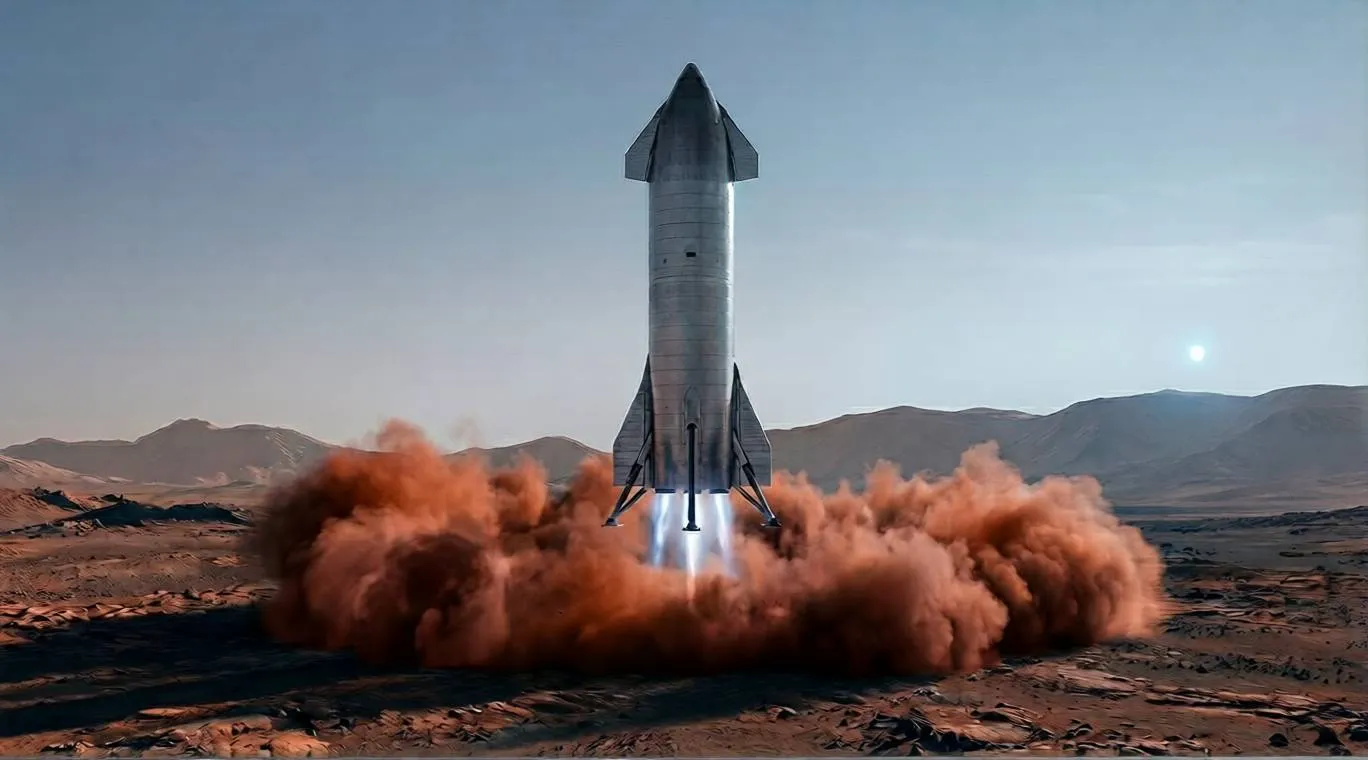
If Japan provides the science, Elon Musk provides the spectacle and industrial risk. SpaceX has marked the calendar for late 2026 with a giant red circle. Their plan is not to send one ship, but a wave.
The strategy is to launch up to five unmanned Starship vessels. The goal is simple but brutal: to test if these gigantic steel ships can survive entry into the Martian atmosphere and land in one piece.
- If the ships land successfully, Musk promises crewed missions for the next window (2028-2029).
- To achieve this, SpaceX must perfect on-orbit refueling in record time, as a Starship needs to "fill the tank" in space before heading to Mars.
- Although many experts doubt they will manage to send five ships, even if just one attempts it, it will change the economics of space transport forever.
Why Aren't NASA or ESA Going?
It's the big question. The reality is that traditional agencies are stuck in a "perfect storm" of logistics and budget. NASA is reorganizing its Mars Sample Return mission because it became too expensive, and ESA had to delay its Rosalind Franklin rover after severing ties with Russia. This has turned 2026 into a "bridge year" or transition year.
| Mission / Project | Agency / Company | Status for 2026 |
|---|---|---|
| MMX (Moons Exploration) | JAXA (Japan) | Launch Confirmed. The leading scientific mission of the year. |
| Starship (Cargo Test) | SpaceX (USA) | Ambitious Plan. Aiming to launch 5 ships. High probability of delays. |
| ESCAPADE | NASA / Rocket Lab | In Flight. Will perform an Earth gravity assist maneuver in Nov. 2026. |
| Artemis II | NASA | Moon Focused. Crewed lunar flyby, diverting attention from Mars. |
Conclusion: A Changing of the Guard in Deep Space
The 2026 window teaches us a valuable lesson: the era where only governments explored Mars is over. We are entering a hybrid phase, where a national agency (Japan) seeks fundamental scientific answers about the origin of the moons, while a private corporation (SpaceX) attempts to build an interplanetary railroad through technological brute force. We may not see new NASA rovers this year, but the seeds of future human colonization will be planted, or will crash, on the red deserts in late 2026.