
What is the Chronological Consensus of the Year 2000?
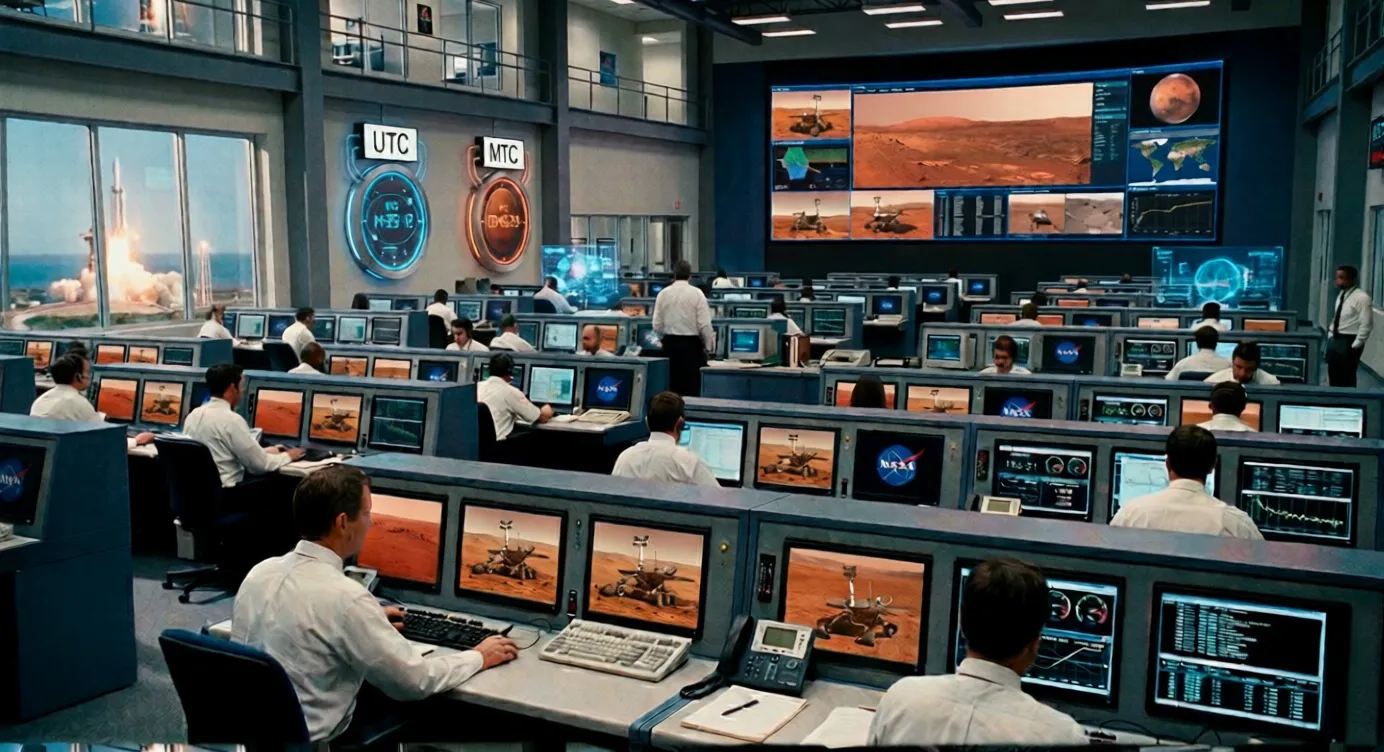
The "Consensus of the Year 2000" was not a diplomatic meeting, but a critical scientific convergence for space exploration. It refers to the moment when the International Astronomical Union (IAU) and NASA standardized, through precise algorithms, how to measure time on the Red Planet, virtually aligning the clocks of Greenwich (Earth) and Airy-0 (Mars).
- Main Objective: To create a common temporal language (Coordinated Mars Time or MTC) so that spacecraft and scientists could share data without errors.
- The Key Milestone: It was determined that near midnight on January 6, 2000, the clocks of both planets coincided almost perfectly.
- The Reference (Zero Meridian): The small crater Airy-0.
- The Solved Problem: The correction of old maps that had position errors due to the lack of prior laser technology.
- The Resulting Tool: The "Mars Sol Date" (MSD), a continuous calendar that counts Martian days since 1873.
The Mystery of the Zero Meridian: From a Smudge to a Crater
To measure time, you first need to know where you are. On Earth, we use the Greenwich Meridian. On Mars, the story was more romantic and solitary. In the 19th century, German astronomers Beer and Mädler chose a simple dark spot near the equator to start drawing their maps. Later, the Italian Schiaparelli named it Sinus Meridiani ("Bay of the Meridian").
However, in the space age, a "spot" is not enough. We needed precision down to meters. In 1971, with the first close-up photos, a large crater named Airy was chosen to honor the British Astronomer Royal. But even that was too large. Finally, scientists zoomed in and selected a small 500-meter crater inside the large one: Airy-0 was born. This small hole in the Martian ground became the point that defines "Zero" longitude and, therefore, the planet's official time.
The problem arose when modern technology arrived. The Airy-0 crater is physical, but the planet rotates in a way that does not always perfectly match old hand-drawn maps or blurry photos. Defining where the day begins on Mars became a mathematical headache.
Interplanetary "Jet Lag" and Elastic Days
Living on Mars is not like living on Earth. A Martian day (called a "Sol") lasts 24 hours, 39 minutes, and 35 seconds. Those nearly 40 extra minutes are a nightmare for conventional terrestrial clocks.
Furthermore, Mars' orbit is much more "stretched" (elliptical) than ours. This causes the planet's speed around the Sun to change drastically. If we used a sundial on Mars, the time would change abruptly depending on the season (much more than on Earth). That is why the agreement of the year 2000 established MTC (Coordinated Mars Time). It is a "mean time," a constant mathematical clock that ignores the variations of the real sun so computers don't go crazy. Thanks to this, NASA engineers can plan missions knowing exactly what time it is, regardless of whether it is summer or winter in the Martian southern hemisphere.
- Step 1: The J2000.0 Epoch. Scientists chose the beginning of the year 2000 as an anchor. They calculated that on January 6, midnight in Greenwich and midnight at Airy-0 occurred at almost the same time.
- Step 2: The Master Equation. They created a formula (based on the work of Allison and McEwen) that allows converting any Earth date into a "Mars Sol Date" (MSD).
- Step 3: The Continuous Counter. They decided that "Day 1" would not be in 2000, but on December 29, 1873, a historical date predating the great classical maps. Thus, January 6, 2000, was Sol number 44,796.
The Big Scare: The 20-Second Error
One of the most surprising discoveries that drove this new consensus was that our maps were wrong. In the late 90s, the Mars Global Surveyor mission used a laser altimeter (MOLA) to measure the shape of Mars with millimeter precision. When overlaying these new laser data with the old maps from the Viking missions of the 70s, scientists were in for a surprise.
The Airy-0 crater was not where we thought it was. There was a longitude error that, translated into time, meant a lag of almost 20 seconds. It may seem small, but for a spacecraft entering the atmosphere at thousands of miles per hour trying to land at an exact point, 20 seconds is the difference between success and disaster. The consensus of the year 2000 corrected this, redefining the planet's coordinates to absorb this error and align the mathematical map with the real terrain.
A Vocabulary for Two Worlds
Thanks to this work, today we have different "types of time" to manage missions. It is vital to distinguish between the time the sun shows and the time the computer clock shows.
| Time Type | Simple Meaning | What is it used for? |
|---|---|---|
| MTC (Coordinated Mars Time) | The "official time" at the zero meridian (Airy-0). | It is the standard for storing scientific data and coordinating spacecraft. |
| LMST (Local Mean Solar Time) | The average time where the Rover is located. | Long-term mission planning (e.g., "When do we wake up the robot?"). |
| LTST (Local True Solar Time) | The real Sun time (like a sundial). | For taking photos (knowing where shadows will be) and charging solar batteries. |
| MSD (Mars Sol Date) | The number of Martian days since 1873. | It is the "universal date" of Mars, avoiding confusing months or leap years. |
Conclusion: The Invisible Foundation of Future Colonization
The "agreement" of the year 2000 did not make newspaper front pages, but it was the invisible foundation upon which modern Mars exploration was built. By correcting maps and standardizing time, we allowed rovers like Perseverance to land with surgical precision. Although today only robots and scientists with altered sleep schedules use it, this time system (MTC and MSD) will, most likely, be the clock used by the first humans to step on the Red Planet, setting the pace of a new civilization millions of miles away from Greenwich.