
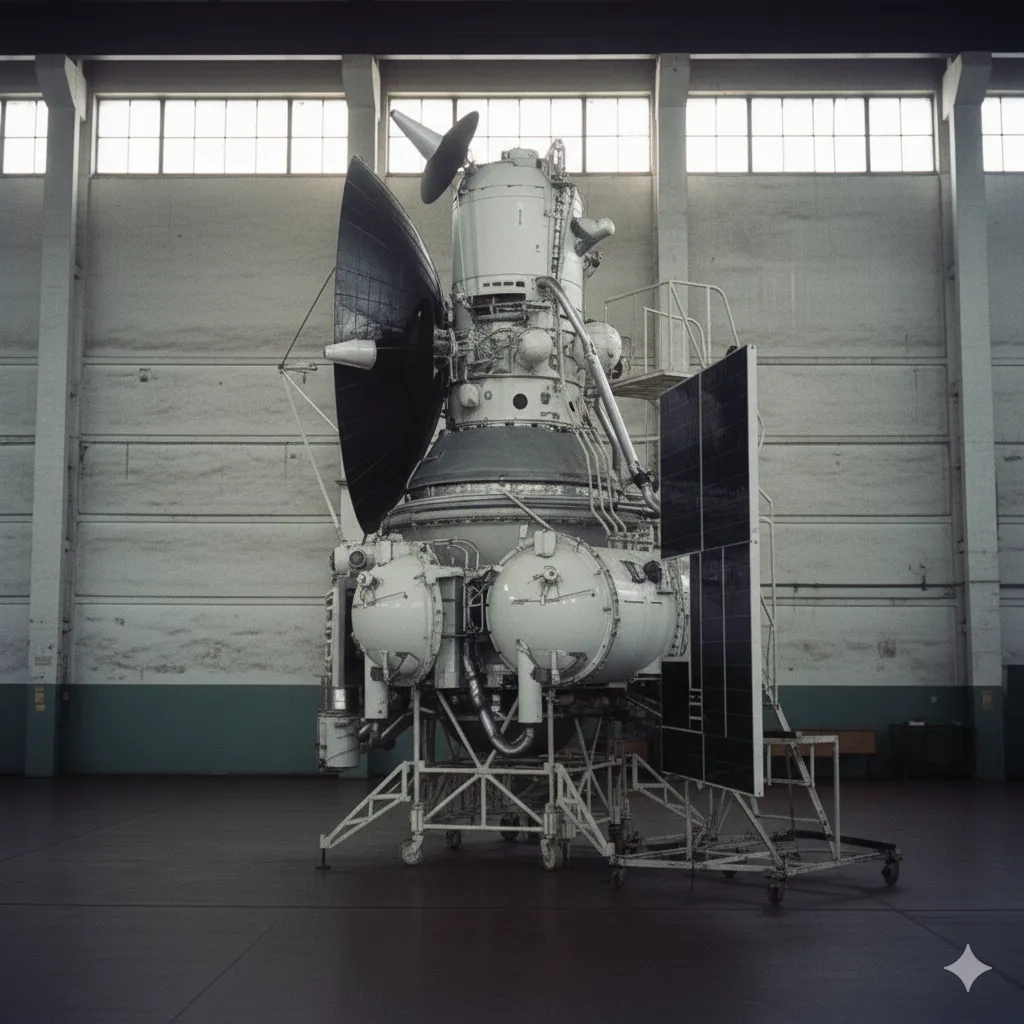
Mars 1969B
The Mars 1969B mission (USSR), internally designated M-69 No.522, was an attempt to send a heavy orbiter to Mars, launched on April 2, 1969. It failed catastrophically and instantly at liftoff when a first-stage engine of the Proton-K rocket failed, causing the vehicle to crash back onto the launch pad and explode.
Agency

Country

Type
Orbiter
Status
Launch
April 2, 1969
Technical Analysis of the Mars 1969B Mission
- Mission Designation: Mars 1969B
- Internal Designation (USSR): M-69 No.522 (or Mars 2M No.522)
- Western Designation: N/A (non-orbital failure)
- Operating Agency: USSR Academy of Sciences (Program managed by NPO Lavochkin)
- Launch Date: April 2, 1969 [cite: 65]
- Launch Vehicle: Proton-K/D (8K82K / 11S824)
- Launch Site: Baikonur Cosmodrome, Site 81/24
1. Mission Objectives
Mars 1969B was the second attempt (after Mars 1969A, launched days earlier [cite: 63]) to launch the new, heavy M-69 (or Mars 3MP) probe. The primary objective was to achieve orbital insertion at Mars, preceding the US Mariner program[cite: 67].
Engineering:
- To validate the M-69 heavy interplanetary spacecraft platform.
- To test the performance of the Proton-K/D launcher for an interplanetary escape mission.
- To execute the first orbital insertion at Mars.
Scientific (Planned):
- To obtain images of the Martian surface and clouds.
- To study the Martian atmosphere via radio occultation.
- To measure surface temperatures using infrared radiometers.
- To investigate the magnetic field, solar wind, and radiation fluxes in the vicinity of Mars.
2. Probe Specifications (M-69 Platform)
The M-69 probe was a second-generation spacecraft, significantly larger and more capable than previous probes.
- Total Mass: Approx. 4,850 kg (including fuel for orbital insertion). The reference document notes they were 5-ton orbiters[cite: 60].
- Architecture: Consisted of a main orbital module (bus) containing avionics, propulsion tanks, and a pressurized instrument compartment.
- Attitude Control: Three-axis stabilization system.
- Power: Two large solar array panels.
- Propulsion: Main propulsion system for Mars Orbit Insertion (MOI) and attitude control thrusters.
3. Scientific Instrumentation (Planned)
The scientific payload was designed for a comprehensive orbital study:
- Imaging System: Several cameras (telephoto and wide-angle) to photograph the surface.
- Magnetometer: To search for an intrinsic magnetic field.
- Spectrometers (UV and IR): To analyze atmospheric composition and surface temperatures.
- Radiation and Cosmic Ray Detectors.
- Radio Occultation Experiment: To probe atmospheric density and pressure.
4. Launch Vehicle
The launcher was the Proton-K/D (8K82K / 11S824). This was a 4-stage configuration designed for high-energy missions beyond Earth orbit.
- Stage 1 (Blok-A): Central core with six RD-253 engines.
- Stage 2 (Blok-B): Four RD-0210/0211 engines.
- Stage 3 (Blok-V): One RD-0212 engine.
- Stage 4 (Blok-D): The escape stage, designed to ignite in a parking orbit for trans-Mars injection.
5. Launch Failure Analysis
The launch of Mars 1969B is one of the most spectacular and violent launch failures of the space age.
- Ignition Sequence (T=0): On April 2, 1969, the ignition command was given to the six RD-253 engines of the Proton-K's first stage.
- Failure Event (T+0.02 s): Almost instantly, one of the first-stage engines (engine No. 4) failed or shut down. The reference document confirms "a catastrophic failure in one of the first stage engines seconds after liftoff"[cite: 65].
- Loss of Control: With severely unbalanced thrust, the 500+ ton rocket lifted only a few meters off the pad, began to tilt dangerously, and lost all stability.
- Impact (T+~3 s): The vehicle collapsed and fell directly back onto the launch pad 81/24.
- Result: The impact caused a massive detonation of the hundreds of tons of toxic hypergolic propellants (Dinitrogen tetroxide and UDMH). The explosion completely destroyed the M-69 probe and the launcher, and it devastated the launch pad , scattering toxic acid and fuel across the complex.
6. Technical Conclusion
The Mars 1969B mission was a total launch failure, classified as "Fracaso en el lanzamiento" (Launch failure)[cite: 272]. The failure was unrelated to the spacecraft, but rather a hardware failure in one of the Proton-K vehicle's first-stage engines. The disaster rendered the launch pad unusable for a considerable time and represented a severe setback for the Soviet Mars program, which lost both of its M-69 probes in less than one week[cite: 60, 61, 65].
Mission Milestones
Launch
Sol 29 of Korolo, Year 8